India
-Gaurav Sharma

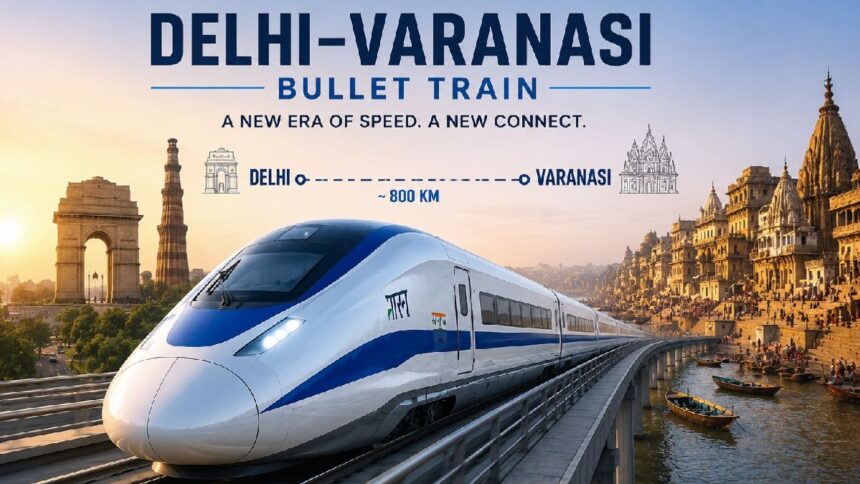
The proposed Delhi-Varanasi bullet train corridor could sharply change travel between western Uttar Pradesh, Lucknow and eastern Uttar Pradesh if it moves from planning to execution. Railway Minister Ashwini Vaishnaw has said the high-speed rail link would bring down the Jewar-Lucknow journey to about 1 hour and 40 minutes, while Delhi-Lucknow travel could take around 2 hours and 10 minutes.
The remarks put renewed focus on the planned corridor, especially because Jewar is emerging as a major transport node with the Noida International Airport project. For passengers in the National Capital Region and Uttar Pradesh, the corridor is being positioned not only as a faster train route but also as a wider connectivity project linking aviation, rail and regional development.
Railway Minister Ashwini Vaishnaw stated the Delhi-Varanasi high-speed rail corridor could enable Jewar-Lucknow travel in about 1h 40m and Delhi-Lucknow in 2h 10m. The project, connecting via Jewar Airport and part of the Union Budget 2026-27, requires revised DPRs and land acquisition.
Vaishnaw made the comments during a programme in Jewar on Saturday. Referring to the proposed alignment towards Varanasi, he said the bullet train would move “just as the Ganga flows” and described the project as a potential game-changer for Uttar Pradesh’s transport and development map.

Delhi-Varanasi bullet train: What travel times have been indicated
According to the travel estimates shared by the minister, the proposed high-speed corridor would make Jewar a key stop between Delhi and Lucknow. The Jewar-Lucknow travel time of 100 minutes would be substantially lower than the time currently taken by road or conventional rail, depending on route, traffic and train category.
The Delhi-Lucknow timing of 2 hours and 10 minutes would also mark a major shift for one of north India’s busiest travel corridors. At present, air travel is faster in flying time, but airport access, security checks and baggage processes add to total journey time. A centrally located high-speed rail system can compete strongly on end-to-end convenience if stations are well connected.
The corridor has gained attention because of Jewar’s growing strategic importance. The under-construction Noida International Airport is expected to serve a large catchment across Delhi-NCR, western Uttar Pradesh, Haryana and Rajasthan. High-speed rail connectivity could widen that catchment and reduce dependence on road access alone.
In April, Jewar MLA Dhirendra Singh met Vaishnaw and sought high-speed rail connectivity to Noida International Airport. Such connectivity is considered important because airports of this scale need multiple feeder systems, including expressways, metro links, buses and long-distance rail.
Why Jewar matters in the proposed high-speed rail plan
Jewar is already linked to major road projects, including the Yamuna Expressway corridor. The airport has also triggered industrial, logistics and real estate planning around the region. A bullet train station or high-speed rail link near the airport would strengthen Jewar’s role as a multi-modal hub rather than only an aviation project.
For Lucknow, faster access to Delhi-NCR and the airport at Jewar could support business travel, tourism and administrative movement. For Varanasi and other cities along the proposed corridor, the benefits would depend on the final alignment, station locations, fare structure and integration with local transport networks.
High-speed rail projects, however, move through several stages before construction begins. These include feasibility studies, detailed project reports, surveys, environmental processes, land acquisition, financing decisions and final approvals. Travel time estimates usually depend on the final route geometry, station halts, design speed and operating plan.
The Delhi-Varanasi corridor is part of a broader high-speed rail push mentioned in the Union Budget 2026-27. Finance Minister Nirmala Sitharaman announced plans linked to seven high-speed rail corridors, while the National High-Speed Rail Corporation Limited has been tasked with taking forward the implementation groundwork.
DPR revision and land acquisition remain key hurdles
The Railway Board has directed the National High-Speed Rail Corporation Limited to revise detailed project reports that had already been prepared for these corridors. A revised DPR typically reassesses route alignment, cost estimates, passenger projections, station plans, construction challenges and implementation timelines.
One of the most important issues will be land. High-speed rail corridors need straighter alignments than conventional tracks because trains operate at much higher speeds. This can make land acquisition more sensitive, particularly in densely populated states such as Uttar Pradesh and in fast-developing regions near Delhi-NCR.
A parliamentary committee has also flagged this concern. In its report on Demands for Grants 2026-27, the Standing Committee on Railways advised the ministry to complete land acquisition and statutory clearances before sanctioning future projects. The committee said this would support time-bound execution and protect financial viability.
The recommendation reflects lessons from large infrastructure projects where delays in land, utilities, environmental approvals and local clearances can raise costs. For a high-speed rail corridor, these delays can be more expensive because civil works, specialised systems, rolling stock and safety technologies require careful sequencing.
India’s only under-construction bullet train project at present is the Mumbai-Ahmedabad high-speed rail corridor. That project has given agencies experience in viaduct construction, station planning, track systems and technology transfer. It has also shown how complex such projects can be when they pass through multiple districts and urban areas.
The Delhi-Varanasi proposal will be watched closely because it covers a politically and economically important belt. Delhi, Noida, Jewar, Lucknow and Varanasi are all high-demand travel points, but the success of the corridor will depend on more than headline travel times. Pricing, frequency, first-mile and last-mile access, and station placement will decide how many passengers shift from road, air and regular trains.
For now, the minister’s travel-time statement gives the clearest indication of the project’s passenger-facing promise. The next decisive steps will be the revised DPR, official approval process, land and clearance progress, and clarity on how the corridor will connect with Noida International Airport and other transport systems in Uttar Pradesh.