


International
-Swastika Sruti

Reports of alleged pressure on Iranian workers, shopkeepers and civic groups to participate in funeral ceremonies for Ayatollah Ali Khamenei have raised questions over how the state is managing public mourning, business closures and crowd mobilisation. The claims, reported by Iran International, describe a coordinated campaign involving unions, local officials, police and Basij-linked personnel in Tehran and other areas.

Reports allege Iranian authorities pressured workers and businesses to participate in Ayatollah Ali Khamenei’s funeral ceremonies, detailing state logistics like food distribution and security for events culminating in a July 9 burial in Mashhad.
The most serious claims could not be independently verified from the material provided. Iranian authorities have not publicly framed the arrangements as coercive. However, the accounts point to a wider pattern of state-led logistics, including business shutdowns, food distribution plans and security restrictions during the dayslong ceremonies.
Claims of pressure on businesses during Khamenei funeral events
According to Iran International, several residents and business owners said they received direct instructions not to operate during the mourning period. One Tehran resident said a text message from a real estate union told offices to remain closed and said members were expected to attend the ceremonies.
Another account from Tehran alleged that Basij members visited shops and warned owners that businesses opening during the funeral days could be sealed. “My parents are shopkeepers. Basij members told our shop and others nearby that if we open during the funeral days, the shop will be sealed,” the resident was quoted as saying.
The reported instructions were not limited to retail shops. A gym owner in Tehran reportedly said fitness centres had been ordered to remain shut from Saturday through Wednesday. Another message cited by the outlet claimed Tehran’s Grand Bazaar had been told to close until Thursday, a move shopkeepers feared would worsen financial pressure on small businesses.
The Grand Bazaar has long carried political and economic significance in Iran. Extended closures there can affect wholesalers, retailers, transporters and daily wage workers. Even short shutdowns can create cash-flow problems for traders already facing inflation, currency weakness and weak consumer spending.
Food, shelter and logistics become part of state mobilisation
The reported pressure also extended to civic and charitable networks. A message from Nahavand in Hamedan province alleged that local officials summoned charitable organisations and asked them to contribute to funeral arrangements. The account claimed organisations were warned that their work could face disruption if they refused to cooperate.
Another allegation involved restaurants in an industrial town near Tehran. Police and Basij members reportedly visited restaurant owners and instructed them to prepare thousands of free meals for mourners. The report said owners were warned that non-compliance could put their businesses at risk of closure.
A Tehran resident also claimed that text messages were circulated urging households to host visitors travelling to the capital for the funeral ceremonies. If accurate, such appeals would suggest authorities were preparing for large numbers of people moving through Tehran and other cities during the mourning period.
Official announcements point to a large logistical operation. The Basij Organization for Guilds said 50 million loaves of bread were being prepared nationwide with the participation of bakers’ unions. It also said 16 mobile bakeries would be deployed across Tehran and surrounding areas to help prevent shortages.
Such arrangements show the scale of planning around the ceremonies. Large state funerals require transport control, crowd management, food supply, security coordination and public communication. In Iran, those tasks often involve government bodies, religious institutions, professional unions and Basij-linked structures working together.
Security restrictions and route of funeral ceremonies
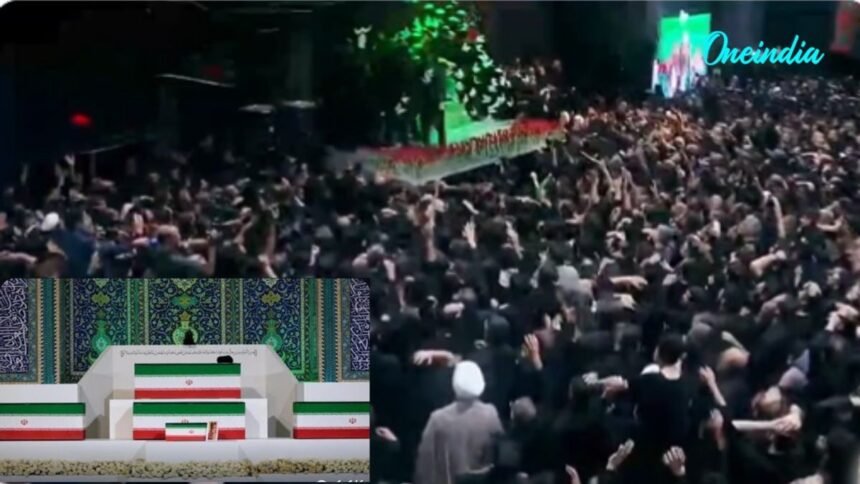
Funeral processions were reported to have begun in Tehran on Saturday, with ceremonies planned to continue through Qom, Najaf and Karbala before burial in Mashhad on July 9. The inclusion of major Shia religious centres would give the ceremonies both national and regional significance.
Authorities also announced heightened security measures, including temporary airspace restrictions over Tehran and Mashhad during the funeral events. Such restrictions are common during major state ceremonies, especially when large crowds and senior officials are expected in sensitive locations.
The reported route underlines the political and religious symbolism attached to the ceremonies. Tehran is the centre of the state, Qom is Iran’s clerical heartland, while Najaf and Karbala hold deep significance for Shia Muslims. Mashhad, home to the Imam Reza shrine, is one of Iran’s most important pilgrimage cities.
For ordinary residents, however, the immediate effects are practical. Shop closures, transport disruption, security checks and crowd-control measures can interrupt daily work. Businesses that depend on daily sales may feel the impact most sharply, especially if closures are enforced rather than voluntary.
The allegations also highlight the difficulty of assessing public participation in tightly controlled political environments. State ceremonies can draw genuine mourners, organised supporters, public employees, students, union members and people who attend under pressure. The visible size of a crowd does not always explain how participation was organised.
Iranian state institutions have often used mass public gatherings to project unity at moments of political stress. At the same time, opposition-linked media and rights groups frequently report coercion around official rallies, elections and commemorations. Each claim requires careful verification, particularly when sources speak anonymously because of possible reprisals.
The latest accounts, if confirmed, would suggest that the funeral arrangements are not only a matter of mourning but also of state capacity and political messaging. The ceremonies are being presented through official logistics, security controls and public mobilisation, while some residents describe economic pressure and fear of penalties.
As the ceremonies continue, the key questions are whether businesses are being allowed to choose their level of participation, how long closures remain in place, and whether authorities respond to allegations of coercion. For many Iranians, the funeral period may be measured not only by public ritual, but also by its effect on work, movement and daily income.