



International
oi-Ashish Rana

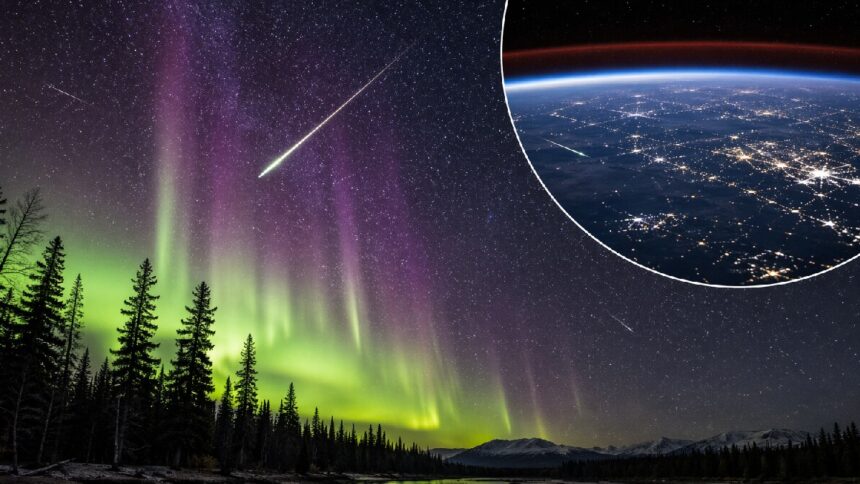
If you stepped outside before dawn on April 22 and looked up, you may have witnessed one of the most beautiful sky events of the year. The Lyrid meteor shower reached its peak as Earth moved through the ancient debris trail of Comet Thatcher, sending bright meteors flashing across the night sky. For many across the Northern Hemisphere, it was a brief but unforgettable reminder of how active and dramatic the universe can look from Earth.

The Lyrid meteor shower peaked on April 22, caused by Earth passing through the debris trail of Comet Thatcher, displaying up to 20 meteors per hour from the constellation Lyra. It is one of the oldest recorded meteor showers and remains active until April 25.
Even if you missed the peak, the Lyrids remain active for a few more nights, though at a lower rate. That makes this the perfect moment to ask: what exactly is a meteor shower, why do the Lyrids happen every year, and what is the story behind the comet that creates them?
Did You Watch the Lyrids? A Short-Lived but Spectacular Sky Show
The Lyrid meteor shower is one of the oldest and most reliable annual meteor displays visible from Earth. This year, it peaked in the early hours of April 22, when Earth crossed the densest part of the dust trail left behind by Comet C/1861 G1 (Thatcher).
At the peak, skywatchers could see up to around 20 meteors per hour under dark and clear conditions. These meteors appeared as fast, bright streaks of light racing across the sky, often seeming to shoot away from the direction of Vega, the bright star in the constellation Lyra.
That “did you watch?” feeling is what makes meteor showers so special. They are not rare in the scientific sense, but they feel personal. You either catch them in the right moment under the right sky, or you miss a celestial event that only lasts for a short window each year.
What Is a Meteor Shower and Why Do Shooting Stars Appear?
A meteor shower happens when Earth passes through a stream of dust and rocky debris left behind by a comet. As the planet moves through this material, tiny fragments enter our atmosphere at very high speed.
When those particles hit the atmosphere, they create friction with the air and burn up, producing the bright glowing streaks we call meteors or, more commonly, shooting stars.
So despite the name, a shooting star is not actually a star. It is usually just a tiny piece of space debris, often no bigger than a grain of sand or a pebble, burning up high above Earth.
Meteor showers are different from random meteors because they happen in clusters and appear to come from the same area of the sky, called the radiant. In the case of the Lyrids, that radiant lies in the constellation Lyra, near Vega, which is why the shower is called the Lyrids.
Why the Lyrids Matter and What Makes Them Special
The Lyrid meteor shower is not the most intense meteor shower of the year, but it is one of the most famous. It has been observed for thousands of years, making it one of the oldest recorded meteor showers in human history.
What makes the Lyrids especially loved by skywatchers is their mix of consistency and surprise. In a normal year, the shower may produce around 10 to 20 meteors per hour at peak, but sometimes it can deliver sudden bursts of activity and particularly bright meteors that stand out against the dark sky.
The Lyrids also arrive in April, when many people in the Northern Hemisphere are beginning to enjoy milder spring nights, making them one of the first major skywatching highlights after winter.
And unlike some meteor showers that are better suited to dedicated astronomy fans, the Lyrids are easy for casual viewers to appreciate. You do not need a telescope. You do not need special equipment. You simply need a dark place, clear skies, patience, and the willingness to look up.
All About Comet Thatcher, the Ancient Source of the Lyrids
The reason the Lyrids appear every April is Comet C/1861 G1 (Thatcher), better known as Comet Thatcher.
This comet was discovered in 1861, but the meteor shower connected to it had already been seen and recorded long before then. That is because the shower is caused not by the comet itself passing close to Earth every year, but by the dust and debris it left behind along its orbit.
As Comet Thatcher travels around the sun, it sheds tiny particles of rock and dust. Over time, these particles spread out into a long debris stream. Every year in late April, Earth passes through part of that stream, and some of those fragments plunge into our atmosphere, creating the Lyrid meteor shower.
What makes Comet Thatcher even more fascinating is that it is a long-period comet. That means it takes hundreds of years to complete one orbit around the sun. So while the comet itself is not something most of us will see in our lifetime, the trail it left behind continues to put on a yearly show in our skies.
In simple terms: the comet is gone, but its path still glows every April.
Why the Meteors Seem to Come From Lyra and Vega
One of the most interesting things about the Lyrids is that the meteors seem to fly outward from a single point in the sky. This point is called the radiant, and for the Lyrids it lies near Vega, one of the brightest stars visible in the Northern Hemisphere.
That does not mean the meteors are actually starting there. It is a matter of perspective, much like railway tracks appearing to meet in the distance. The meteors are moving in parallel paths through Earth’s atmosphere, but from our viewpoint on the ground, they appear to spread out from the same region of the sky.
This is why skywatching guides often tell observers to look generally toward the Lyra-Vega region, even though meteors can appear across many parts of the sky.
Can You Still Watch the Lyrids and What Comes Next?
Although the peak has passed, the Lyrid meteor shower remains active until April 25, which means there is still a chance to catch a few bright meteors over the next several nights. However, the number of meteors drops quickly after the maximum, so the display will be much quieter than it was at peak.
If you missed it, there is still good news for skywatchers. The next major meteor shower is the eta Aquariids, expected to peak on the night of May 5-6. That shower can be even more active, with rates potentially reaching around 50 meteors per hour under ideal conditions.
So if the Lyrids slipped past you this year, another chance to watch the sky is already on the calendar.
Why Meteor Showers Still Feel Magical Every Year
Meteor showers are one of the rare astronomy events that instantly connect science with emotion. You can explain them with orbital mechanics, comet debris, atmospheric friction, and radiant points, but when you actually see one, it still feels like magic.
The 2026 Lyrids were more than just a seasonal sky event. They were a reminder that Earth is constantly moving through a living solar system filled with ancient comet trails, invisible dust streams, and moments of sudden beauty.
And that is what makes the Lyrids special every year. They are not just about watching meteors. They are about realising that even a comet discovered in the 19th century can still leave behind a spectacle that makes people stop, look up, and ask the same question:
Did you watch it?