



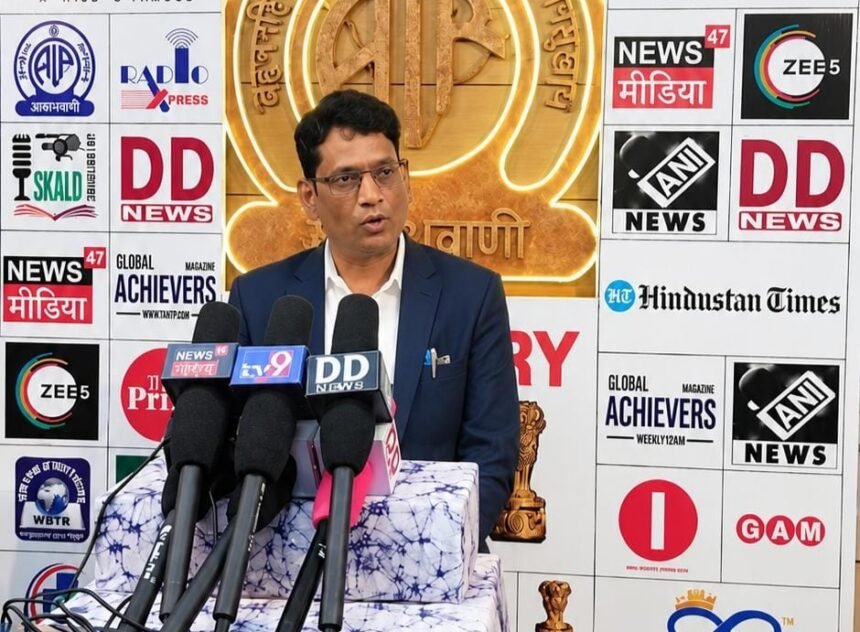
Dr. Sanjay Venutai Pandurang Kamble, a social worker and education advocate from Maharashtra’s Yavatmal district, has spent nearly three decades working towards the development of disadvantaged communities. Since beginning his social work journey in 1997, he has been associated with initiatives covering child education, child labour rehabilitation, women’s empowerment, disability rehabilitation, rural healthcare and community development. Through organisations including Bhimashishya Magasvargiya Bahuuddeshiya Vikas Sanstha and Bhartiya Swayamsevi Sanstha Mahasangh (India), his work has focused on expanding opportunities for vulnerable groups and strengthening community participation.
His initiatives reflect a personal understanding of economic insecurity. Born on 13 January 1980 in Khandala village in Yavatmal district, Dr. Kamble grew up in a financially disadvantaged household. His father worked as a labourer, while his mother frequently suffered from ill health. With three sisters to support, the family faced considerable challenges in meeting educational and household expenses.
Turning Personal Struggles into Social Action
Dr. Kamble’s educational journey required years of determination. Sent to Darwha while studying in Class Five, he continued his schooling while living with relatives. After Class Ten, he moved to Yavatmal for further education and undertook several jobs, including work at grocery and clothing shops and construction related labour. He later worked at a hotel in Nagpur while pursuing his studies. At times, financial difficulties left him without food for two consecutive days.
After completing DDM&A H and entering employment, he later returned to his native region and continued his education alongside social work. He completed his Bachelor of Social Work and Master of Social Work, earning his postgraduate qualification from Chaudhary Charan Singh University, Meerut, in 2007.
His father’s death around 1999 brought further responsibilities, including supporting his mother and ensuring that his sisters could continue their education and build their futures. These experiences strengthened his understanding of the difficulties faced by families without adequate financial or social support.
Educational Opportunities for Disadvantaged Children
One of Dr. Kamble’s significant contributions has been his work for children affected by labour and poverty. Between 1999 and 2004, informal night classes were organised for working children. With UNICEF’s collaboration, educational centres were established in eight villages to help children who worked during the day access learning opportunities.
He also pursued English medium education for rural and disadvantaged children. Despite resource constraints, local opposition and administrative challenges, the initiative continued. In 2009, an important milestone was achieved with official permission to operate a primary school, helping extend educational access to children in the region.
His work subsequently expanded to residential education and rehabilitation for children with intellectual disabilities, incorporating educational support, healthcare, speech therapy and skill development. An initiative for residential education for children with hearing impairments was also pursued in 2025.
Strengthening Women and Rural Families
Women’s economic empowerment remains another major area of activity. According to the information provided by his organisation, more than 700 women’s self help groups have been developed through initiatives associated with his work. These groups aim to connect women with livelihood opportunities, small enterprises, agricultural activities and government schemes.
His wider social work also addresses the concerns of farmers, agricultural labourers, families affected by farmer suicides, young people seeking vocational skills and residents of disadvantaged urban communities. Health initiatives, addiction awareness campaigns and rural development activities form part of this broader engagement.
During the COVID period, efforts to strengthen collaboration among voluntary organisations gained importance. The organisation reports that its wider social network has connected more than 800 voluntary organisations, supporting cooperation and knowledge sharing across the social sector.
A Community Based Approach to Family Security
Dr. Kamble has also promoted the concept of Aapla Parivar Suraksha Kavach, an initiative rooted in the need to strengthen financial security for ordinary families. Inspired partly by his experience of losing his father and assuming family responsibilities at a young age, the concept seeks to encourage support for households facing unexpected crises.
The initiative reflects a broader concern that the death or incapacity of an earning member should not leave a family without support or force children to abandon their education.
His contributions have received recognition through honours including the District Youth Award from Nehru Yuva Kendra, the Dr. Babasaheb Ambedkar State Level Samata Award, the Global Achievers Award, the Visionary Indian Award and several national and international recognitions.
With reported initiatives reaching more than 600 children through education, over 400 children through disability related residential education or rehabilitation activities, and communities across more than 30 villages, Dr. Kamble’s work brings together education, inclusion and collective responsibility.
His message is particularly relevant to young people. He believes that education can change the direction of an individual’s life and that personal hardship can become a source of understanding and service. His journey demonstrates how sustained community engagement can help turn individual struggles into opportunities for wider social progress.