



International
oi-Madhuri Adnal

An Omani co-pilot who allegedly attacked the captain and attempted to take control of a flydubai flight carrying 166 Israelis and eight other passengers has been described by a fellow pilot as a religious extremist.
The co-pilot allegedly attacked Captain Smit Machchhar as flydubai flight FZ1073 was travelling from Dubai to Tel Aviv on Wednesday morning. Passengers and crew members then intervened and wrestled with him as the aircraft plunged thousands of feet before eventually making an emergency landing in Tabuk, Saudi Arabia.
An Omani co-pilot allegedly attacked Captain Smit Machchhar and attempted to seize control of flydubai flight FZ1073 (Dubai-Tel Aviv), causing the Boeing 737 Max 8 to plunge 14,000ft before an emergency landing in Tabuk, Saudi Arabia; passengers intervened, and the co-pilot was arrested.

The fellow pilot, who spoke anonymously to Israel’s Channel 16, said the Omani national had joined flydubai around eight months ago.
“He prayed excessively throughout the day and refused to shake hands with women,” the pilot told the network.
Channel 16 foreign editor and news anchor Yosef Yisrael said he had spoken to a colleague of the alleged attacker who did not want to be identified.
In a translated account, Yisrael said the colleague described the co-pilot as displaying “very strange behaviour”, particularly in relation to religious observances that were considered out of step with his surroundings at flydubai.
The colleague reportedly said the co-pilot prayed frequently and would not shake hands with women.
According to Yisrael, the source also expressed regret over the incident and accused flydubai of having “betrayed Israel”.
“There is no other way to put it, we hired the services of a terrorist and nearly caused the deaths of 180 people,” Yisrael quoted the colleague as saying.
The confrontation unfolded while flight FZ1073 was cruising at altitude between Dubai and Tel Aviv.
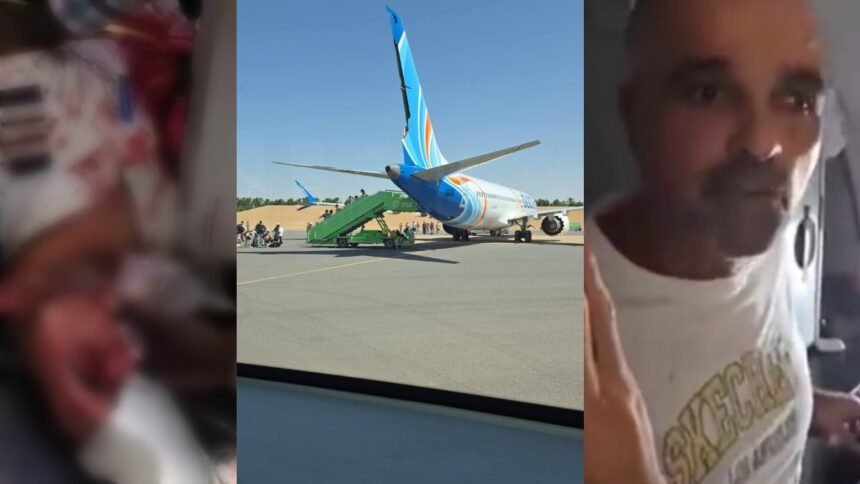
Passengers and crew members reportedly fought with the co-pilot after he allegedly attacked Machchhar and attempted to take control of the Boeing 737 Max 8. The aircraft then plunged 14,000 feet in just 29 seconds, leaving Machchhar severely wounded and lying on the floor covered in blood.
A British off-duty pilot is believed to have been among those who helped passengers and crew regain control of the aircraft.
The flight transmitted the general emergency squawk code 7700 while making a U-turn near the border between Saudi Arabia and Jordan. It later briefly transmitted code 7500, which signals unlawful interference or a possible hijacking.
The emergency signals raised fears that the incident could turn into another September 11-style attack. Officials said passengers had prevented an “Israeli 9/11” by restraining the alleged attacker.
A person who heard the crew’s mayday call with air traffic control said the pilot’s voice was trembling as he reported that a hijacking was taking place and that ambulances would be needed.
The aircraft was initially denied clearance to land in Saudi Arabia and was directed towards Jordan, according to the account. The crew was reportedly told to wait for clearance from the Jordanian military before the aircraft was turned away.
The pilot then returned towards Saudi Arabia and said he had to land in Tabuk. Air traffic control operators reportedly gave no reason for the earlier refusals. The aircraft eventually landed at Tabuk airport in Saudi Arabia.
Machchhar was seriously injured during the confrontation. Distressing footage showed the captain lying on the floor covered in blood as passengers attended to him. Another pilot appeared to be lying unconscious nearby.
Passengers could be heard telling one of the men: “You saved the plane.”
Machchhar was praised for helping protect the 174 passengers on board, including four Americans. Delhi’s embassy in Saudi Arabia confirmed that he was being treated at a hospital in Tabuk. Passengers and crew members were also hailed for their role in preventing what was described as a suspected suicide mission.
Israeli Prime Minister Benjamin Netanyahu announced on Wednesday afternoon that the alleged attacker had been arrested and was “currently being questioned by the Saudi authorities”. His identity, intention and motive had not been confirmed.
Israel’s Defence Minister Israel Katz described the incident as “an attempted jihadist terror attack”, saying it had been thwarted by several Israeli passengers.
One of the passengers, identified by local media as Yaniv Hayun, was later called a “hero” by Netanyahu during a meeting after his return to Tel Aviv.
Hayun, wearing a blood-soaked T-shirt, described how he broke down the cockpit door and wrestled with the alleged attacker before taking control of the aircraft. He credited his familiarity with aviation emergencies partly to watching the television programme Air Disasters.
The aircraft’s dramatic descent has also drawn attention from aviation experts.
According to Flightradar24, the Boeing 737 Max 8 plunged from 33,000 feet to 17,000 feet, or around 10,000 metres to 5,100 metres, in about a minute. It then made an erratic circle close to the Jordanian border before landing in Tabuk around an hour later.
United Airlines pilot and aviation safety expert Steve Arroyo said he was surprised the aircraft was able to land safely after most of the rudder was reportedly ripped off the tail during the extreme descent.
“That was a serious descent and strong aerodynamic forces on that rudder for that to happen. I’m just amazed the aircraft didn’t come apart,” Arroyo said.
Aviation safety expert Jeff Guzzetti said the aircraft may not have been able to level out if it had fallen below 10,000 feet given the rate of descent.
“It is remarkable they were able to pull out of that dive. What saved them is there was enough altitude left for them to recover,” said Guzzetti, who previously investigated crashes for the National Transportation Safety Board and the Federal Aviation Administration in the US.
Flydubai said it was suspending flights to and from Israel while it investigates Wednesday’s incident.
Israel is also probing how the Omani co-pilot was cleared to operate a flight bound for Israel, particularly given that Oman has no diplomatic relations with Israel and foreign crew flying into its airspace are strictly controlled. The co-pilot’s intention and motive have not yet been confirmed.