


India
oi-Ashish Rana

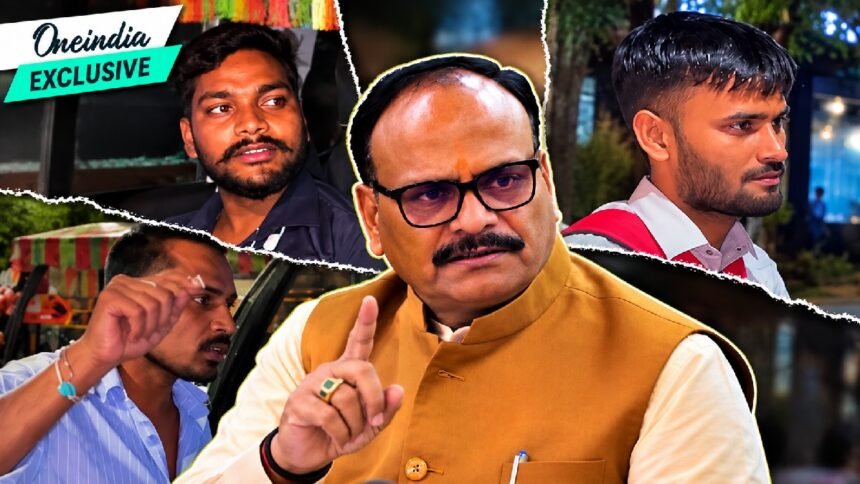
Ground Report: Uttar Pradesh Deputy Chief Minister Brijesh Pathak’s recent advice to young people to stop chasing jobs and consider driving taxis has triggered a debate about whether self-employment through driving is really as easy and financially rewarding as it sounds.

Uttar Pradesh Deputy CM Brijesh Pathak’s suggestion for self-employment through driving taxis, promoted via Bharat Taxi, contrasts with reports from drivers facing long hours, low net income, loan difficulties, and dignity issues.
Pathak made the remarks while promoting Bharat Taxi, telling people that instead of working for someone else, they could drive their own vehicles for a few hours, earn money and spend more time with their families. His comments were made in the context of promoting self-employment, but the remarks have since been widely discussed as a message to young people looking for jobs.
बीजेपी के डिप्टी CM Brajesh Pathak बोल रहे है कि क्या करोगे नौकरी लेकर रिक्शा चलाओ ,
इन लोगों ने पूरे प्रदेश को सर्कस बना दिया है। pic.twitter.com/WjW24TW2Kb
— खुरपेंच Satire (@Khurpench_) September 27, 2026
So, what happens when you ask people who are already doing exactly what Pathak is suggesting?
OneIndia spoke to an e-rickshaw driver from Bihar, a bike taxi rider from Uttar Pradesh and a cab driver from Lucknow to understand the reality of earning a living on the road. Their answers point to long working hours, low take-home income, difficulty in getting loans, vehicle-related expenses and, in one case, a concern that goes beyond money: dignity.
‘If E-Rickshaw Driving Is Enough, Why Do We Need Education?’

Sushant Singh, E-rickshaw driver from Bihar
Singh’s response to Pathak’s message was blunt. He questioned the idea that driving an e-rickshaw could be presented to rural youth as a sufficient employment option.
“If driving an e-rickshaw is what we have to do, then why do we need education? Have children, increase the population and leave them on the roads to keep driving e-rickshaws,” Singh said.
He questioned whether political leaders would want their own children to follow the same path.
“If this is what the government wants, why are the sons of ministers and politicians not driving e-rickshaws? Why are they sending their children abroad to study?” he asked.
For Singh, the issue is not simply about finding work. He said people from financially weaker backgrounds often struggle to obtain loans that could help them build another livelihood.
“Education loans and business loans are not easily available. Even getting a car loan is not that easy,” he said.
Singh said he had himself approached a bank to obtain a loan to open a shop but was unable to get it approved.
His experience of e-rickshaw driving also challenges the impression that the profession can easily provide a comfortable daily income.
“I earn around Rs 600 to Rs 700 for the entire day, even after working for 13 to 14 hours,” he said.
Singh also raised the issue of dignity.
“An e-rickshaw driver can be abused by anyone and people simply move on. Does the government want a father to drive an e-rickshaw, then his son and then his grandson to keep driving an e-rickshaw?” he asked.
He also pointed to a practical issue with the Bharat Taxi debate. According to Singh, e-rickshaws are not currently available on the Bharat Taxi platform in the same way four-wheelers are, making the promotion of Bharat Taxi different from the reality of his own work.
’15-16 Hours Of Work Gives Me Only Rs 500-600 After Fuel’

Ashok, bike taxi rider from Hardoi, Uttar Pradesh
For Ashok, who works as a bike taxi rider, the idea of simply using one’s vehicle to create employment also sounds easier on paper than it is on the road.
“It is not easy. The government says we should put a commercial number plate on our bikes, but that is not easy either,” Ashok said.
He said the income from bike taxi work is not high enough to make the economics straightforward.
“If we work for 15 to 16 hours, we can make around Rs 700 to Rs 800. Around Rs 200 goes towards fuel. That leaves only Rs 500 to Rs 600,” he said.
He questioned how a rider could then pay taxes and run a household from the remaining amount.
Ashok also described the rates he receives for individual rides.
“For a 7-kilometre ride, we get Rs 50. That is not even Rs 10 per kilometre,” he said.
According to him, the rate changes depending on demand and can sometimes fall to around Rs 6 or Rs 7 per kilometre, while at other times it reaches around Rs 8 per kilometre.
His account raises a basic question about how daily income from driving should be calculated.
A rider may make Rs 700 or Rs 800 in gross collections, but that is not necessarily the amount that reaches the household. Fuel, maintenance, taxes and other costs have to be deducted before calculating actual earnings.
‘A Taxi Can Run A Household, But Getting A Car Is Not Easy’

Abhishek Rawat, taxi driver from Lucknow
Abhishek Rawat, who drives a taxi in the Delhi-NCR region despite being from Lucknow, offered a more measured response to Pathak’s suggestion.
Rawat does not believe taxi driving is impossible as a livelihood. In fact, he said it can support a family. But he stressed that income depends heavily on the number of rides.
“Sometimes the work is very slow and sometimes it is good. It depends on how the rides are coming,” Rawat said.
“A person driving a taxi can run a household if they want to,” he added.
But when asked whether getting a car loan is easy for a middle-class person, his answer was clear.
“No. The biggest problem is the payment. Having Rs 1.5 lakh to Rs 2 lakh at one time is very difficult for a middle-class person,” Rawat said.
He believes government intervention could make it easier for people to enter the sector.
“If the government wants, loans can be made available,” he said.
But owning a taxi is only the beginning, according to Rawat. The daily expenses and risks associated with driving also add up.
“There are many difficulties in driving a car, including road accidents, highway challans, MCD tolls and parking tolls,” he said.
‘Even If I Earn Rs 5,000 A Day, There Should Be Respect’
For Rawat, however, the most striking problem is not necessarily the income.
He said he drives outside his home city partly because of the social perception attached to being a cab driver.
“In your own city, your acquaintances and relatives know you. Anyone can book an online cab. Even your own cousin can book your cab,” he said.
According to Rawat, this can make driving a commercial vehicle in one’s own city uncomfortable.
“Driving a taxi in your own city feels embarrassing. People on the road, traffic police and passengers do not give you enough respect. Once they see a commercial number plate, anyone can try to put pressure on you. Someone can even slap you and walk away,” he alleged.
For him, the issue is therefore not only about how much money a driver makes.
“Even if I earn Rs 5,000 a day, there should be respect in this profession too,” Rawat said.
Three Drivers, Three Experiences, One Question
The three drivers do not represent every taxi, bike taxi or e-rickshaw driver in Uttar Pradesh or India. Their earnings are individual accounts, not a survey of the sector.
But their experiences offer a ground-level perspective that is missing from a simple argument over whether young people should become drivers.
Pathak’s central argument was that owning and driving one’s own vehicle can provide independence, income and greater control over family time. Bharat Taxi itself has been designed as a cooperative-led platform in which drivers, known as Sarathis, can become members and stakeholders. The Union government says the platform follows a zero-commission model and is intended to promote employment and self-employment.
The idea, therefore, is not simply about asking people to become taxi drivers. It is also about changing the relationship between drivers and ride-hailing platforms.
But the three drivers OneIndia spoke to point towards the other side of the equation.
- What happens before a person gets behind the wheel?
- Can they get a loan to buy the vehicle?
- Can they afford the down payment?
- How many hours will they have to work?
- What will remain after fuel and maintenance?
- Can they pay taxes and other charges?
- Will there be enough passengers?
And perhaps most importantly, will the work provide dignity along with income?
Before Asking Young People To Drive, Ask Existing Drivers
The responses from the three drivers also raise a larger question for policymakers.
If driving is being presented as an employment opportunity for young people, should the government first ask existing drivers what is making their work difficult?
An e-rickshaw driver working 13 to 14 hours and reporting Rs 600-700 in daily earnings has a very different experience from the picture of easy self-employment.
A bike taxi rider working 15 to 16 hours and reporting Rs 700-800 before fuel has another reality.
And a cab driver who says taxi driving can support a family but points to the difficulty of arranging a Rs 1.5 lakh to Rs 2 lakh down payment highlights yet another barrier.
The government can promote entrepreneurship and self-employment. There is nothing inherently wrong with encouraging young people to become their own bosses.
But being one’s own boss does not automatically mean having a secure income.
The three drivers’ accounts suggest that the employment debate needs to move beyond the question of whether driving is respectable work. It needs to ask whether the profession is financially sustainable, whether drivers have access to affordable credit and basic infrastructure, and whether they receive the dignity they deserve.
Pathak’s remarks may have been intended to promote a new avenue of self-employment through Bharat Taxi.
But after speaking to the people already earning their living on the road, one question remains difficult to ignore:
Before telling India’s young people to drive, has the government asked the drivers already on the road what they need?