



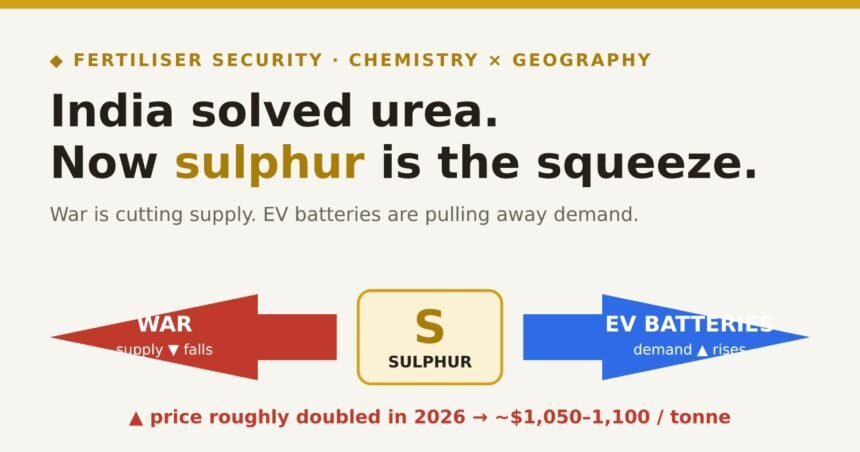
India kept its urea supply steady through two wars. But a quieter raw material sits at the very start of the phosphate-fertiliser chain — and it is now being pressed from two sides: war is cutting supply, while electric-car batteries are pulling away demand.
1The win: how India held the urea line
Urea is India’s most-used fertiliser. It carries nitrogen, the nutrient behind leafy green growth. Its whole story is really a natural-gas story.
Making urea is a chain reaction that starts underground with gas, not with any mined mineral:
This created a double exposure. India imports finished urea, and imports the LNG (liquefied natural gas) its own plants burn to make urea — and much of both came from the same neighbourhood.
20–30%
of India’s urea imports came from the Gulf
~50%
of India’s LNG imports came from the Gulf
Geography: where India’s urea came from in 2025
When the 2026 West Asia conflict hit, gas to Indian plants dropped — then recovered
✓ And the farmer barely felt it Even as global urea prices climbed, the retail price of a 45-kg urea bag stayed fixed at ₹266.50. The subsidy absorbed the international shock.
2The new weak point: sulphur
Urea was one battle. But it is only one nutrient. Phosphorus — vital for roots, flowering and grain-filling — comes through DAP, SSP and NPK fertilisers. And those quietly depend on sulphur.
Why sulphur is fragile: almost nobody mines it
⚠ The war connection Ukraine’s strikes on Russian oil-and-gas infrastructure, and conflict around Iran and Gulf energy facilities, reduce refinery activity — and with it, the sulphur that comes out as a byproduct.
The chemistry: why India can’t skip sulphur
Rock phosphate holds phosphorus, but plants can’t absorb it raw — it must be chemically unlocked. That unlocking runs on sulphuric acid, which runs on sulphur:
3.8–3.9
million tonnes of sulphur India uses a year
2–2.1
million tonnes of that go to fertiliser makers
52%
of India’s sulphur was imported in 2024–25
And the price has roughly doubled
3Pressed from both sides
What makes this different from the urea scare is that it isn’t only a supply problem. A brand-new buyer has walked into the same market.
◄ Supply side · WAR
- Sulphur is ~90% a byproduct of oil & gas.
- Strikes on Russian energy infrastructure cut refinery output.
- Conflict around Iran and Gulf facilities adds to the disruption.
- Less refining → less sulphur reaches the market.
DEMAND side · EV BATTERIES ►
- Sulphuric acid is needed to process nickel.
- Indonesia turns laterite ore into EV-battery material.
- That has sharply lifted acid demand.
- New appetite arrives just as supply tightens.
◆ The analytical point A commodity long treated as a throwaway byproduct of oil and gas has quietly turned strategic — sitting at the crossroads of two national priorities: food security and the global energy transition. Byproducts are dangerous exactly because no one plans their supply; it simply appears — or doesn’t.
4Why it matters for the Indian farmer
Urea is secured, but urea is only nitrogen. Phosphorus — the nutrient behind strong roots, flowering and yield — flows through DAP, SSP and NPK. If sulphur stays scarce and dear, the cost and reliability of that half of the fertiliser basket is what comes under strain.
The government has already directed Indian refineries to ensure enough sulphur reaches fertiliser companies and is examining ways to stabilise supplies of sulphur and other critical inputs — treating a former byproduct as a strategic input for agriculture.
Nitrogen
Urea — supply held steady ✓
Phosphorus
DAP · SSP · NPK — the sulphur-linked worry
Solved Watch this The urea chapter shows the system can absorb a shock when it plans for it. Sulphur is the reminder that the next shock can enter through a door no one was watching.