


India
oi-Swastika Sruti

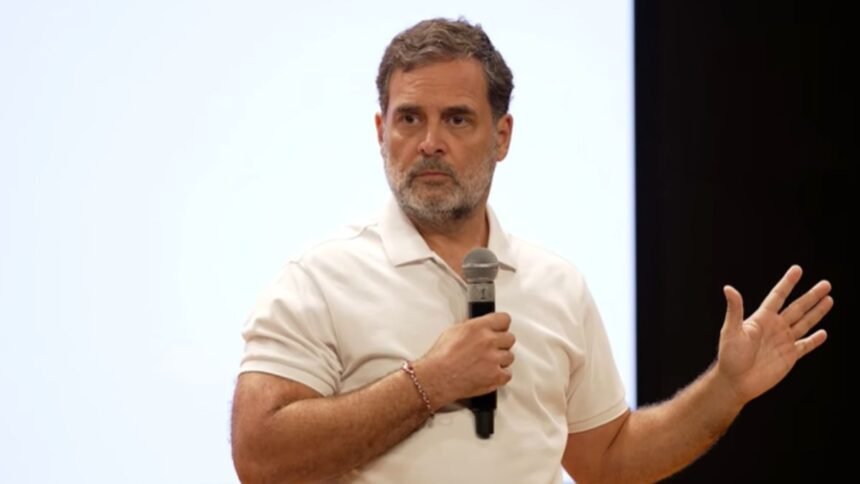
Congress Party’s leader and Opposition Leader in Lok Sabha, Rahul Gandhi, has once again attacked Election Commission and its Chief Election Commissioner Gyanesh Kumar in a press conference held on Thursday, September 24, 2009, in the backdrop of the controversy surrounding the Special Intensive Revision (SIR) of electoral rolls.

Rahul Gandhi accused the Election Commission and CEC Gyanesh Kumar of attacking democracy through electoral roll changes, citing internal commissioner objections reported by Indian Express. He questioned the absence of anti-incumbency against the BJP and alleged a wider conspiracy affecting institutions and elections.
According to him, this is not only an issue related to change in voter list but this is actually an attack on democracy and constitutionalism in India. His allegations are based on questions which he had raised in the last three years about elections in Haryana, Maharashtra, and Karnataka.
These allegations come after an investigative report by Indian Express revealed that the two election commissioners of Election Commission, viz. Sukhbir Singh Sandhu and Vivek Joshi, have at least 14 times objected over the period of 10 months on decisions related to electoral rolls, voter list and Election Commission’s system.
‘Why Has Anti-Incumbency Disappeared?’

Gandhi started off asking himself a question regarding the lack of anti-incumbency factor in states which have seen the BJP rule continuously for years.
He made references to Indian politics and gave examples of the former Prime Minister of India, Indira Gandhi saying that even those governments which have been highly popular amongst voters will face backlash in time.
Afterwards, Gandhi asked himself why this same trend was not affecting the current Prime Minister Narendra Modi, Home Minister Amit Shah and the BJP.
Gandhi talked about states like Haryana, Maharashtra, Uttar Pradesh, Madhya Pradesh and Gujarat, and stated that political power had often shifted in many of these states.
While he was able to understand popularity of a political figure or performance of a government, he did not understand how anti-incumbency can go missing.
#WATCH | Delhi: Reacting to Indian Express report on 2 ECs objecting to discrepancies in SIR process, LoP Lok Sabha, Rahul Gandhi says, “The first thing we are saying is Mr. Gyanesh Kumar must resign immediately. I would add to Mr. Gyanesh Kumar: You are a highly educated person.… pic.twitter.com/hCACV3lYT7
— ANI (@ANI) September 24, 2026
Gandhi made comparisons between the political systems of countries like Iraq under Saddam Hussain and North Korea in his arguments on elections and political continuity.
‘Vote Is The Foundation Of India’
A central part of Gandhi’s speech was his argument that the vote is the foundation on which India’s constitutional system operates.
He said that when a citizen votes, the person is effectively exercising their political power through the Constitution.

According to Gandhi, votes determine who enters Parliament, the Rajya Sabha and state legislatures. Those elected representatives then make laws, while the country’s institutions operate within the framework of those laws.
He therefore argued that if citizens’ voting rights are undermined, the wider constitutional system is also affected.
#WATCH | Delhi: Reacting to Indian Express report on 2 ECs objecting to discrepancies in SIR process, LoP Lok Sabha, Rahul Gandhi says, “… On 21st December 2023, a strange law was passed. A law was passed that makes the election commissioner immune to investigation. He is… pic.twitter.com/jkoBscKEXF
— ANI (@ANI) September 24, 2026
Gandhi described what he alleged was a chain of events as:
“Vote chori, law chori and then institution chori.”
He alleged that changes to electoral outcomes could ultimately affect the laws made by elected representatives and, subsequently, the institutions operating under those laws.
Gandhi Alleges A Wider ‘Conspiracy’
Gandhi alleged that the issue was not limited to the Election Commission.
He named Adani, RSS chief Mohan Bhagwat, Amit Shah, Prime Minister Narendra Modi, National Security Adviser Ajit Doval and Gyanesh Kumar while referring to what he described as a wider conspiracy.
These are allegations made by Gandhi and have not been established by a court.
He further alleged that institutions, including the bureaucracy, education system and judiciary, had been filled with people associated with the RSS.
Gandhi argued that if the electoral process itself is compromised, the legitimacy of decisions taken afterwards could also come under question.
#WATCH | Delhi: Reacting to Indian Express report on 2 ECs objecting to discrepancies in SIR process, LoP Lok Sabha, Rahul Gandhi says, “The Election Commission is the institutional protector of the vote… I have shown it with proof, and there is already more than enough… pic.twitter.com/iFvXjYkvjY
— ANI (@ANI) September 24, 2026
Why Did Rahul Gandhi Question Gyanesh Kumar’s Appointment?
Gandhi also went back to December 2023, when Parliament passed legislation changing the framework for selecting the Chief Election Commissioner and Election Commissioners.
He alleged that the law effectively placed the Election Commission outside the normal legal system and provided protection to officials such as Gyanesh Kumar.
Gandhi questioned who had brought the law and alleged that the legislation was designed to protect officials who would subsequently work in favour of the government.
However, the legal change he referred to was the Chief Election Commissioner and Other Election Commissioners (Appointment, Conditions of Service and Term of Office) Act, 2023. The legislation changed the selection mechanism and provided specified legal protections for the CEC and Election Commissioners; it did not simply place them “outside the legal system.” The bill was passed by Parliament in December 2023.
#WATCH | Delhi: Reacting to Indian Express report on 2 ECs objecting to discrepancies in SIR process, LoP Lok Sabha, Rahul Gandhi says, “I want to put some points across here about what has recently been in the news… I come from a political family, and I have spent more than 50… pic.twitter.com/VnDeKvRXZO
— ANI (@ANI) September 24, 2026
February 17: Gandhi Says His Objection Was Ignored
Gandhi referred to a February 17 press conference and said he had earlier written to Prime Minister Modi raising objections over Gyanesh Kumar’s role.
He claimed that the opposition had made its concerns about Kumar clear but that those objections were not considered.
Gandhi argued that the controversy now surrounding the Election Commission had given additional context to those earlier concerns.
August 7: ‘Vote Chori’ Campaign In Mahadevapura
Gandhi also referred to his campaign against alleged electoral irregularities.
He said that on August 7, he undertook what he described as a “Vote Chori” campaign in Mahadevapura, a Bengaluru constituency that had previously featured prominently in his allegations concerning voter-list irregularities.
The Congress has repeatedly used Mahadevapura as an example while alleging discrepancies in electoral rolls. The Election Commission has disputed allegations of deliberate voter manipulation.
August 16 To September 1: Vote Adhikaar Yatra
Gandhi then referred to the Vote Adhikaar Yatra, which took place between August 16 and September 1. The Congress-led campaign focused on voter rights and alleged irregularities in electoral rolls.
Gandhi said these campaigns were part of a broader effort to draw attention to what he described as “vote chori”.
September 23: Indian Express Investigation
Gandhi’s latest attack came a day after The Indian Express published its investigation into internal objections within the Election Commission.
The report said Election Commissioners Sukhbir Singh Sandhu and Vivek Joshi had raised objections at least 14 times over 10 months.
The reported objections related to issues including voter registration, deletion and restoration of names, appeals and access to electoral-roll systems.
The report became a major political flashpoint, with opposition parties demanding action against Gyanesh Kumar.
‘2024 Election Was Fake’: Gandhi’s Claim
Gandhi made one of his strongest claims when he alleged that the 2024 Lok Sabha election and subsequent Assembly elections were “fake”. This is a political allegation, not an established finding. The Election Commission has rejected allegations that its processes were manipulated and has defended the integrity of the electoral system.
Gandhi argued that the reported internal objections by two Election Commissioners strengthened the questions he had been raising about the electoral process.
Gandhi’s Advice To Gyanesh Kumar: ‘Turn Approver’
Gandhi directly addressed Chief Election Commissioner Gyanesh Kumar during the press conference. He argued that the two other Election Commissioners had done what he described as the right thing by recording their objections.
Gandhi then advised Kumar to “turn approver“, suggesting that the CEC should cooperate with any future investigation into the allegations.
He described the alleged actions as a serious crime and warned that there would be consequences.
‘This Will Not Go Unanswered’
Towards the end of his press conference, Gandhi said the Congress and opposition parties were committed to pursuing the matter. He said investigations into Narendra Modi and Amit Shah would be pursued regardless of political circumstances.
Gandhi said the opposition would not allow what he described as a crime against democracy to go unanswered.