


India
oi-Swastika Sruti

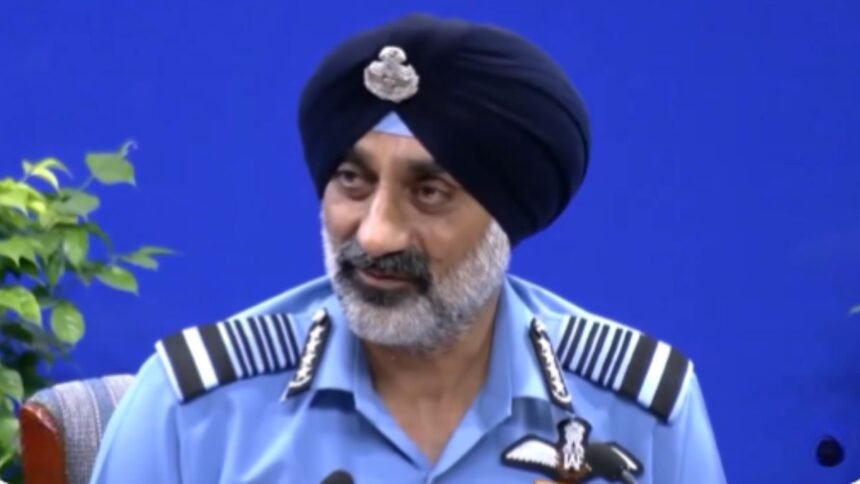
IAF Chief Air Chief Marshal Amar Preet Singh has expressed concern about the reduction in the number of fighter squadrons, pointing out that delays in the induction of new aircraft have been impacting the operational strength of the force.

Ahead of retirement, IAF Chief Air Chief Marshal Amar Preet Singh highlighted the force’s 29 fighter squadrons, below the 42.5 sanctioned, due to induction delays, stressing the need for 36-40 jets annually to enhance operational strength.
Addressing his last media briefing as IAF Chief prior to his retirement on October 31, he said that the IAF now has 29 fighter squadrons, which is way below the sanctioned number of 42.5.
He said that it has to be made up by induction of around 36-40 fighter aircraft per year in the coming years.
However, while raising this point, he emphasized that this shouldn’t be seen as an indication of weakness.
“We have less numbers, but we are not weak,” he said.
VIDEO | Delhi: We may have to look at other fighter platforms in case of delays in AMCA fifth-generation, other programmes. Russia has offered Su-57 jets but no decision has been made on it, says Indian Air Force Chief Air Chief Marshal AP Singh.#IAF #IndiaAirForce
(Full video… pic.twitter.com/rYIGhDznn2
— Press Trust of India (@PTI_News) October 3, 2026
IAF Needs 36-40 Fighter Jets Every Year
Singh added that the delays in procuring and inducting fighter aircraft have become a matter of grave concern, especially considering the retirement of the entire MiG-21 fleet.
“It is so that you plan for something but it gets delayed. But in this case, the delay has been very long,” he added.
Once again highlighting the fact that “delayed technology means denied technology”, he emphasized the need to modernize promptly.
The IAF chief said that his air force has to induct about 36 to 40 aircraft each year for several years to make up for the existing deficit and future retirements.
The requirement, he added, could be even more than the current requirement owing to India’s security scenario.
Rafale, LCA Mk1A And Mk2 To Fill The Gap
The IAF is looking at multiple fighter aircraft programmes to strengthen its fleet.
Singh said the force is looking towards:
- Multi-Role Fighter Aircraft (MRFA)
- LCA Mk1A
- LCA Mk2
- Advanced Medium Combat Aircraft (AMCA)
These programmes are expected to play different roles in replacing retiring aircraft and expanding the fighter fleet.
On the proposed acquisition of 114 fighter aircraft from France, Singh said the MRFA contract is expected to be signed during the current financial year.
The IAF is also evaluating other options. Singh confirmed that Russia has offered its Su-57 fifth-generation fighter aircraft to India, although no decision has been taken on the proposal.
AMCA Programme Remains A Key Priority
The Air Chief also made mention of India’s future program for its AMCA fifth generation fighter aircraft.
According to him, while full support is being given to the program by the IAF, he emphasized that any delay might necessitate other considerations for the force.
“Let us see how it goes,” said Singh, further stating that in case of any delays, “other things will need to be considered.”
The AMCA program aims at giving India its own indigenous fifth generation fighter capability in the future.
Pakistan’s J-35 Plans A ‘Cause For Worry’
Singh also expressed concern over reports that Pakistan is looking to acquire Chinese J-35A fifth-generation stealth fighter aircraft and that Pakistani pilots are undergoing training in China.
He described the reports as a “cause for worry.”
Pakistan has been reported to be considering the acquisition of up to 40 J-35A aircraft, which would make it one of the first foreign operators of China’s fifth-generation fighter platform.
The IAF is closely watching developments in Pakistan’s air power capabilities as India works to modernise its own fighter fleet.
‘Integration Matters The Most’
Reflecting on recent military operations, Singh said the performance of a military does not depend only on the number of platforms it possesses.
He referred to Operation Sindoor and said Pakistan had several military platforms but failed to achieve much because their integration was inadequate. According to Singh, the experience demonstrated the importance of connecting different systems and platforms so that they can work together effectively.
This includes fighter aircraft, air defence systems, surveillance platforms, missiles, drones and command-and-control networks.
IAF Wants An AI-Augmented Force
The Air Chief also highlighted the growing role of artificial intelligence in modern warfare.
He said the IAF needs to develop an “AI-augmented force”, indicating that artificial intelligence will increasingly be used to support decision-making, surveillance, data analysis and battlefield operations.
Singh said the future of military power is increasingly centred around the aerospace domain, with advanced fighter aircraft, long-range precision weapons, integrated air command systems and unmanned aerial systems becoming increasingly important.
‘Atmanirbharta Cannot Come At The Cost Of Defence Readiness’
On India’s push for self-reliance in defence manufacturing, Singh said Atmanirbharta is a necessity, but it cannot come at the cost of operational preparedness.
“Atmanirbharta can’t happen overnight,” he said.
According to him, India needs to build the complete defence manufacturing ecosystem, including technology, production capacity, supply chains and supporting industries.
He said India is moving in the right direction but acknowledged that questions could be raised about whether the pace of progress is sufficient.
IAF Not Against Theatre Commands
Singh also addressed the issue of theatrisation, under which the armed forces are being reorganised into integrated theatre commands. He said the IAF is not opposed to theatre commands, but argued that the lessons from Operation Sindoor and the changing security environment need to be considered before taking a final decision.
The Air Chief suggested that India’s military structure should take into account the operational realities that have emerged from recent conflicts.
No Separate Drone Force For Now
The IAF chief also ruled out the need for a separate drone force.
Instead, he said unmanned systems and loitering munitions should remain integrated with the IAF’s existing weapons and platforms.
Singh described drones as an “evolutionary” capability and said their numbers, types and operational applications are being expanded.
The approach indicates that the IAF wants unmanned systems to become part of its wider combat structure rather than operate as an independent force.
‘Strong Military Needed To Protect National Interests’
Singh stressed that military strength remains important for a country’s ability to protect its interests. He said recent conflicts have demonstrated the increasing importance of air power as a key element of military capability.
According to him, global defence transactions and strategic discussions increasingly focus on advanced fighter aircraft, long-range precision weapons, integrated air command and control systems and unmanned aerial systems.
These developments, he said, show the growing importance of aerospace power in modern warfare.
Air Chief Praises Pilot Smit Machchhar
During the press conference, Singh also praised Indian pilot Captain Smit Machchhar, who was injured during the recent flydubai cockpit attack.
Machchhar was reportedly attacked by his co-pilot while flying from Dubai to Tel Aviv. The aircraft was carrying 174 passengers, including 27 children.
Despite suffering injuries, Machchhar managed to open the cockpit door, allowing others to enter and help bring the situation under control.
Singh described the pilot’s actions as exceptional.
“What our Indian pilot has done is exceptionally great. He showed presence of mind, physical resolve, and mental resolve. It is also a lesson for us,” the IAF chief said.
‘No Individual Is Bigger Than The Institution’
As he prepares to retire, Singh credited the entire IAF for its achievements rather than attributing them to any one individual.
“No individual is bigger than the institution,” he said.
However, he added that as the head of the organisation, he was prepared to personally accept responsibility for any shortcomings.