


International
oi-Prakash KL

Saudi Arabia’s push for deeper security ties with the United States is coming under renewed scrutiny after Washington moved ahead with a potential $24.3 billion sale of F-35 fighter jets to Riyadh, even as President Donald Trump has held back from directly joining the kingdom’s fight against Iran-backed Houthi forces in Yemen.
The developments come alongside Saudi moves that could strengthen its strategic alignment with Washington, including its reported withdrawal from a China-led digital currency project and the announcement of a major uranium-bearing ore discovery.
Amid renewed Houthi attacks, Saudi Arabia is pursuing a potential $24.3 billion US F-35 jet sale and announced a major uranium discovery, while President Trump decided against direct military intervention in Yemen, highlighting complex strategic dynamics between Riyadh, Washington, and Beijing.

Taken together, the moves have drawn attention to the changing dynamics between Riyadh, Washington and Beijing at a time when Saudi Arabia is facing renewed attacks from the Houthis and seeking greater US security support.
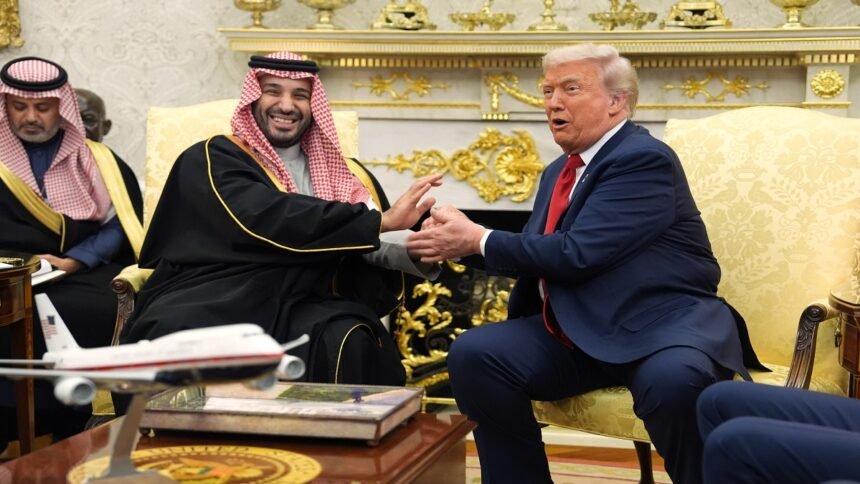
The New York Times reported that Trump spent weeks considering whether to intervene in Yemen after Saudi Crown Prince Mohammed bin Salman pressed him to help contain the Houthi advance. Trump initially opposed direct US military action but later instructed the Pentagon to prepare strike options following a conversation with the crown prince.
US commanders subsequently approved targets and began preparing aircraft and weapons. Trump, however, decided on Sunday not to proceed with the strikes, at least for now, according to the newspaper.
The decision came as Washington maintained indirect communication with the Houthis through Oman. The group has indicated that it does not want to target US vessels and has sought to keep its confrontation focused on Saudi-linked interests, according to recent reports.
For Riyadh, the threat has become increasingly serious. Houthi forces have launched missiles and drones towards Saudi Arabia, including attacks involving Riyadh and energy infrastructure. The renewed fighting has raised concerns over both Saudi security and important shipping routes around the Red Sea and Bab el-Mandeb.
Against that backdrop, the Trump administration’s decision to move forward with the F-35 sale carries particular significance.
The US State Department on September 17 notified Congress of a proposed sale of 48 F-35A fighter jets and 49 engines to Saudi Arabia. The package, which includes training, logistics, communications and electronic warfare support, has an estimated value of $24.3 billion. The sale still requires congressional consideration.
If completed, Saudi Arabia would become only the second country in the Middle East to operate the F-35, after Israel. The proposed transfer has also raised concerns within US intelligence circles over the possibility of sensitive technology being exposed to China because of Riyadh’s relationship with Beijing, The New York Times reported.
The timing has added another layer to the debate over Saudi Arabia’s strategic direction.
Earlier in September, Saudi Energy Minister Prince Abdulaziz bin Salman announced that geological exploration in the Madinah region had identified about 110 million tonnes of ore containing promising concentrations of uranium and heavy rare earth elements. The announcement was made during the International Atomic Energy Agency’s general conference in Vienna.
The discovery is part of Riyadh’s wider push to expand its mining and nuclear-energy ambitions. Saudi Arabia has also been pursuing closer cooperation with Washington on civilian nuclear energy.
Then came another development involving China.
The Financial Times reported that Saudi Arabia had withdrawn from mBridge, a China-led cross-border digital currency initiative designed to allow central banks to conduct transactions using digital currencies. Saudi Arabia’s central bank said its participation ended after a planned technical test, while sources cited by the newspaper suggested Riyadh was also conscious of possible US scrutiny over the project.
The Saudi decision is significant because mBridge has been viewed as part of efforts to develop alternatives to traditional dollar-based cross-border payment infrastructure. The project continues to involve China, Hong Kong, Thailand, the UAE and Macau, according to the Financial Times.
None of these developments, on their own, establishes that Saudi Arabia is offering economic or strategic concessions to secure military support from Trump. The sequence has nevertheless fuelled speculation about how Riyadh is balancing its long-standing security partnership with Washington against its economic and strategic relationship with Beijing.
For Trump, the Saudi relationship presents its own dilemma. Riyadh remains an important US partner, but direct American military intervention against the Houthis could open another front in an already widening regional conflict.
The F-35 decision, meanwhile, points to a deeper defence relationship even as Washington weighs the risks of transferring highly sensitive technology to a country with close links to China.
Saudi Arabia is therefore pursuing several tracks at the same time – seeking American security guarantees and advanced military technology, developing its nuclear and mineral resources, and recalibrating parts of its engagement with China.
How those moves ultimately affect the balance between Riyadh’s ties with Washington and Beijing remains a key question as the conflict involving the Houthis and Iran continues to reshape the region.
With inputs from NYT, Reuters