


Spotlight
oi-Oneindia Staff

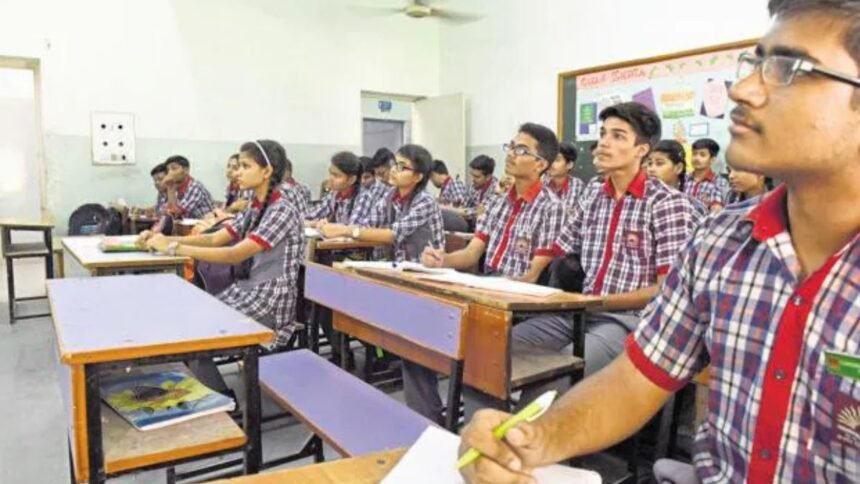
For decades, the public conversation surrounding middle-class financial security in urban India revolved around two structural pressure points: real estate inflation and catastrophic medical expenses. Yet quietly, almost insidiously, a third vulnerability has outpaced both.

Private school tuition in urban India has become an existential financial drain for the middle class, a crisis potentially addressed by Tamil Nadu’s 2009 Act which created an independent statutory committee to determine rationalized fees based on audited financial data.
Private school tuition has transformed from a predictable household expense into an existential financial drain.
In major Indian metropolitan hubs, basic primary and secondary education for a single child now routinely costs between ₹1.5 lakh and ₹4 lakh annually. Driven by non-refundable “development funds,” mandatory technology surcharges, inflated transport fees, and arbitrary annual hikes, parents find executive power locked into a system operating without a regulatory ceiling.
Schooling has been financialized. Thereby, shifting from a foundational public good into a high-yield commodity that families are forced to secure at any cost.
The Middle-Class Policy Vacuum
This crisis stems from a deep policy asymmetry. State welfare programs rightly focus on subvention, healthcare access, and food security for low-income populations, while higher education institutions are bound by statutory fee committees and accreditation frameworks, though the implementation of these initiatives and results obtained are highly questionable across all states. Salaried and middle-income households, however, operate in a policy vacuum.
Neither eligible for state-subsidized primary education nor wealthy enough to absorb unchecked price increases, many families now spend 30% to 50% of a single earner’s income solely to keep a child enrolled in a mid-tier private institution.
Governments frequently treat private educational pricing as a matter of free-market enterprise. But private schooling is not an open market; it is a captive one. Once a child enters an institution, switching schools involves significant academic and emotional disruption, giving school managements near-monopolistic leverage over parents.
Treating this relationship as a pure “buyer-seller negotiation” ignores the severe power imbalance between commercial school managements and parents attempting to protect their children’s educational continuity.
The Statutory Benchmark: Tamil Nadu’s Model
Effective regulatory templates already exist within India’s legal framework. Under the Tamil Nadu Private Schools (Regulation of Collection of Fee) Act, the state instituted a dedicated, independent statutory body: the Private Schools Fee Determination Committee led by a retired High Court Judge. The law was passed by the legislative assembly of Tamil Nadu under DMK Chief Minister M. Karunanidhi in 2009.
Rather than applying uniform statewide price caps that ignore institutional variances, this framework relies on transparent, audited parameters. Private schools must submit verified balance sheets, expenditure reports, staff salary ledgers, and infrastructure details. The statutory committee evaluates these submissions to fix a rationalized fee structure tailored to the institution, valid for three years. This mechanism checks profiteering while ensuring that schools maintaining genuinely high-standard facilities receive fair operational compensation.
The absence of similar independent statutory oversight across major metropolitan states has left millions of urban parents exposed to unmediated annual fee surges.
The High-Yield Trap: How Commercialized K-12 Kills Pedagogical Value
The financialization of school fees does more than erode household savings; it fundamentally alters the quality of learning inside the classroom. When K-12 education operates on a high-margin corporate framework, institutional priority shifts from human development to measurable, marketable branding.
The Illusion of “Global Infrastructure”
To justify high entry barriers and recurring capital charges, private institutions often engage in an infrastructural arms race. Capital is redirected into visible assets: climate-controlled corridors, synthetic sports turfs, interactive display boards, and franchise curriculum designations.
Yet behind this polished presentation, core educational investments often lag:
• Teacher Compensation Deficits: Despite escalating fee collection, instructional staff frequently receive stagnant wages with minimal job security, leading to high teacher turnover.
• Complicated Rote Learning: To demonstrate visible “returns” to paying parents, early childhood programs are often compressed into high-pressure test-preparation pipelines-training young students for standardized evaluation rather than critical thinking or problem-solving.
• Reduction of Foundational Skills: Holistic learning, practical vocational skills, physical recreation, and creative arts are frequently converted into paid extra-curricular additions or scaled back to maximize classroom seating capacity.
Restoring Education as a Statutory Priority
The unrestrained commercialization of K-12 education creates a compounding problem: as public school systems face resource constraints, unregulated private operations step in, charging prices that undermine equity and replace pedagogical development with corporate positioning.
If state policy aims to address urban cost-of-living pressures and safeguard long-term human capital, educational fee regulation must become a central welfare priority. Access to transparently priced, high-quality schooling is a basic economic protection. Instituting independent fee determination committees, auditing private institutional finances, and enforcing legal caps on non-tuition levies are essential steps toward curbing exploitation and restoring structural focus to the classroom.
(Akash Kolluru is National Spokesperson Of Telangana Rakshana Sena (TRS))