


India’s vehicle scrappage carbon credits are revolutionizing corporate net-zero goals. Discover how the new Carbon Credit Trading Scheme transforms end-of-life vehicles into verifiable carbon assets, offering a crucial ‘circular dividend’ for ESG reporting. This innovative approach unlocks immense potential for automotive OEMs, fleet operators, and financiers to achieve sustainability targets.
In The News
-Staff

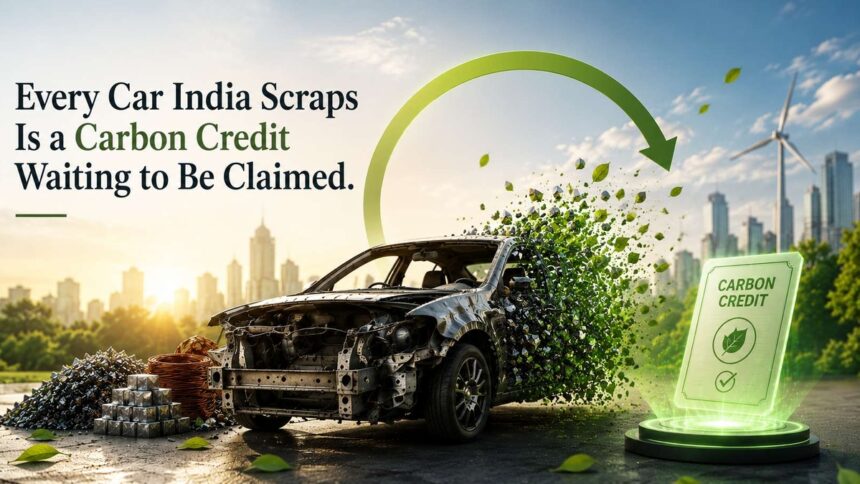
Every Car India Scraps Is a Carbon Credit Waiting to Be Claimed: Why Mobility’s Circular Dividend Is the Missing Piece in Corporate Net Zero. Every scrapped vehicle in India carries a number that has, until now, gone uncounted. Embodied inside its steel, aluminium, copper, and plastic is a quantum of carbon that took energy to mine, smelt, and assemble. When the vehicle reaches end of life, recycling that material avoids a fresh round of primary production and the emissions that come with it. The resultant dividend is real and measurable. The problem has never been the value. It has been the absence of verification at the moment the value is created.
However, that absence is closing. India’s Carbon Credit Trading Scheme is set to begin formal trading within months, the Indian Carbon Market portal is live for registration and verification, and the infrastructure to translate vehicle scrappage into a traceable carbon asset is already running. For corporate India, this changes the arithmetic of net zero. The end of the mobility lifecycle, long the blind spot of automotive ESG reporting, is becoming a registry entry.
India’s vehicle scrappage carbon credits are revolutionizing corporate net-zero goals. Discover how the new Carbon Credit Trading Scheme transforms end-of-life vehicles into verifiable carbon assets, offering a crucial ‘circular dividend’ for ESG reporting. This innovative approach unlocks immense potential for automotive OEMs, fleet operators, and financiers to achieve sustainability targets.

Why End-of-Life Vehicles Remain a Major Scope 3 Emissions Gap
Automotive emissions reporting has spent a decade closing the gaps it can see. Cleaner manufacturing has trimmed Scope 1. Renewable procurement has begun to bend Scope 2. Fleet electrification and fuel efficiency norms have started to chip at Scope 3 transport categories. Each is a documented improvement, supported by audited data and reported in BRSR disclosures.
What none of these address is what happens after the vehicle leaves the road. Roughly 75 to 80 percent of an automotive company’s lifecycle emissions sit in the supply chain. A vehicle scrapped in an informal yard often loses its Vehicle Identification Number (VIN) on dismantling, with its sequence going unrecorded, and the emission reduction associated with reusing its metals dissolves into anonymous scrap flows. There is nothing for an auditor to verify, and nothing for a registry to issue against.
What India’s Compliance Calendar Just Changed
The notification of the Carbon Credit Trading Scheme on 28 June 2023 opened the policy door. The market itself was still under construction until recently. That changed at the Prakriti 2026 International Conference on Carbon Markets, where Union Power Minister Manohar Lal confirmed that formal trading will begin within a few months, with the Indian Carbon Market portal already accepting registrations.
According to the International Carbon Action Partnership’s (ICAP) March 2026[1] update, the compliance track initially covers around 490 obligated entities across seven notified sectors. Aluminium, cement, chlor-alkali, pulp and paper, petroleum refining, petrochemicals, and textiles all sit inside this perimeter, with iron & steel and fertiliser expected to follow once their final targets are notified. ICAP had also noted in its November 2025 update[2], once fully operational across all nine sectors, the scheme is set to cover over 700 million tonnes of CO₂e, placing India among the world’s largest emissions trading systems by coverage. [3] [4]
Every Indian vehicle manufacturer, fleet operator, financier, and OEM carries indirect exposure to a market that will price the carbon intensity of the materials they buy. For automotive enterprises outside the compliance perimeter, the voluntary offset track is the relevant entry point, and ELV carbon credits sit at the centre of it.
How a Scrapped Vehicle Becomes a Verifiable Carbon Asset
The mechanism is already operational and something more than just theory.
A vehicle arrives at a Registered Vehicle Scrapping Facility (RVSF) authorised under the Motor Vehicles (Registration and Functions of Vehicle Scrapping Facility) Rules, 2021[5] [6] (later revised in 2022 and 2024). The intake is logged against VAHAN, blacklist and hypothecation checks are completed, and the vehicle moves through a depollution and dismantling sequence governed by AIS 129 and Central Pollution Control Board (CPCB) guidelines. Structured operational data is captured at each step: vehicle deposit details through Form 2, 2-A and 2-C, weight by material, vehicle make-model, homologation category while vehicle scrapping, and the Form 4 Certificate of Vehicle Scrapping.
This data becomes the foundation of every credit issued. It flows into a digital tracking system that records each step of the scrapping process, creating a verifiable trail for every vehicle that goes through the pipeline. The records are stored on a secure, tamper-proof ledger, and the emission savings are calculated using globally accepted carbon accounting methodology built on long-established UN framework. As a result, each credit can be linked back to respective vehicles, scrapped at a specific facility, on a specific date. That level of traceability is something the wider voluntary carbon market has historically struggled to offer.[7] [8]
This is the infrastructure that MMCM has brought into operation. AutoLoop is the operating system RVSFs use to capture the data and the in-house developed carbon methodology converts the dismantling activity into a documented climate asset, sits on top of both.
Who Can Benefit From ELV Carbon Credits
The credit is the unit; the buyer determines the market. Across the automotive value chain, four buyer categories now have a defined pathway into the same instrument.
- OEMs gain a verifiable Scope 3 lever that ties end of life stewardship to a specific batch of vehicles, with retirement records that hold up under audit
- Logistics and fleet operators can match credit generation to fleet decommissioning cycles, closing the carbon loop on the same assets that drive operational emissions
- ESG buyers gain access to a credit class with per vehicle traceability that the broader voluntary market has historically struggled to deliver
The Future of Carbon Credits From Vehicle Recycling in India
India is projected to generate nearly 50 million end of life vehicles by 2030, according to NITI Aayog. Between August 2022 and July 2025, roughly 3,50,500 vehicles were processed through registered facilities, just under 3 percent of the eligible population. The remaining 97 percent represents emissions reductions that currently have no documentation, no registry entry, and no market value. The mid 2026 trading launch closes the timing gap. The methodology, the verification framework, the registry infrastructure, and the operational data capture are already in place. Mobility’s circular dividend is no longer a missing piece. It is a registry entry waiting to be claimed, one verified vehicle at a time.