Mumbai
oi-Oneindia Staff

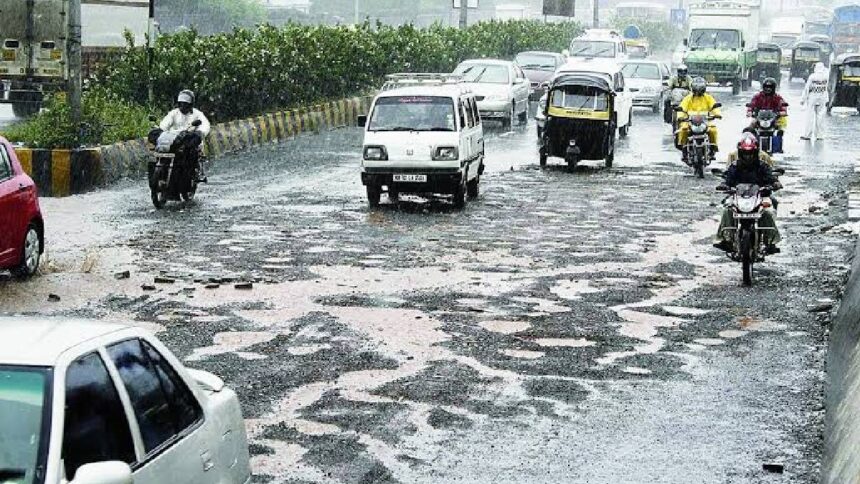
Mumbai: Every monsoon, Mumbai witnesses the same cycle-heavy rains, cratered roads, traffic chaos, accidents involving two-wheelers, hurried repairs and public outrage that fades once the rains recede. According to Advocate Rakesh Kumar Singh, Social Activist and Senior Managing Partner of leading law firm RKS Associates, the city’s recurring pothole crisis is less about the intensity of the monsoon and more about a governance system that has failed to prioritise accountability.
“A country that has successfully landed a spacecraft near the Moon’s south pole should not be struggling to keep a major city road intact through one rainy season,” Advocate Rakesh Kumar Singh said. “The contrast naturally raises questions about whether our infrastructure failures are merely accidental or the result of a system that rewards short-term fixes over long-term durability.”
Mumbai’s recurring pothole issue stems from governance failures prioritizing cheap repairs over durability, but a landmark October 13, 2025 Bombay High Court order mandates accountability for officials and contractors to ensure safer, longer-lasting roads.

According to Advocate Rakesh Kumar Singh, the popular belief that roads are deliberately built badly for repeated repair contracts oversimplifies a much deeper structural problem.
“There may not be a conspiracy to build poor roads,” he said. “But when every incentive in the system rewards the cheapest construction, weak supervision and recurring repair work, the outcome begins to resemble one. You don’t need deliberate sabotage when flawed incentives produce the same result.”
He pointed out that Mumbai is not suffering from a shortage of financial resources. The Brihanmumbai Municipal Corporation (BMC), one of Asia’s wealthiest civic bodies, allocated nearly ₹5,100 crore for roads and traffic in its 2025-26 budget. The civic body is also implementing a ₹17,000-crore road concretisation project covering around 700 kilometres, in addition to more than 1,300 kilometres of roads already concretised.
Despite these massive investments, a former Standing Committee Chairman had acknowledged that the corporation once spent nearly ₹800 crore annually merely on repairing potholes.
“That is not simply a maintenance issue,” Advocate Rakesh Kumar Singh observed. “When taxpayers repeatedly pay to repair roads they have already paid to build, it signals a deeper institutional failure. The recurring expenditure is a symptom of a system that does not sufficiently reward quality or enforce accountability.”
Beyond the financial losses, Advocate Rakesh Kumar Singh stressed that the human cost is immeasurable. He cited the example of Dadarao Bilhore, popularly known as Pothole Dada, whose 16-year-old son, Prakash, died in 2015 after his motorcycle hit a pothole left unattended following civic roadwork. Since then, Bilhore has personally filled more than 1,500 potholes across Mumbai in an effort to prevent similar tragedies.
He also referred to petitions before the courts alleging 18 pothole-related deaths on Thane’s Ghodbunder Road between January and October 2025, describing them as reminders that poor infrastructure is not merely an inconvenience but a serious public safety issue.
According to Advocate Rakesh Kumar Singh, India’s engineering standards for roads are not fundamentally deficient. Instead, the implementation process is where the system breaks down.
He explained that government contracts are generally awarded to the lowest bidder under the L1 tendering system. Contractors who aggressively underbid often attempt to recover their margins during execution by reducing material quality, laying thinner bitumen layers, using inferior aggregates or compromising on compaction. Meanwhile, contractors proposing higher-quality and longer-lasting construction frequently lose the tendering process.
He also highlighted the chronic lack of coordination among civic departments. Newly constructed roads are often excavated within weeks for utility works such as water pipelines, electricity cables and telecommunications infrastructure, only to be patched with loose material that deteriorates during the next spell of heavy rain.
Drawing comparisons with global practices, Advocate Rakesh Kumar Singh noted that cities such as Singapore require agencies digging roads to restore the pavement to its original structural strength, while Tokyo has significantly reduced repeated excavation through dedicated underground utility corridors.
He further argued that another major weakness lies in the poor enforcement of the five-year Defect Liability Period, under which contractors are expected to repair defects at their own cost. In practice, inspections remain inconsistent and penalties are often too insignificant to deter negligence.
A major shift, according to Advocate Rakesh Kumar Singh, has now emerged through judicial intervention.
Referring to the Bombay High Court’s landmark order of 13 October 2025, delivered by Justices Revati Mohite Dere and Sandesh Patil in a suo motu public interest litigation, he noted that the Court declared safe roads to be an integral part of the fundamental right to life under Article 21 of the Constitution.
The judgment directed compensation of ₹6 lakh for every pothole or open manhole-related death, compensation ranging from ₹50,000 to ₹2.5 lakh for injuries, mandatory repair of potholes within 48 hours, and personal financial liability on negligent officials and contractors, along with provisions for blacklisting and prosecution in serious cases. The Court also observed that roads should ordinarily remain durable for five to ten years.
“The Bombay High Court has fundamentally changed the conversation,” Advocate Rakesh Kumar Singh said. “For years, poor construction carried almost no personal consequences. Once negligence begins to attract financial liability and professional accountability, building durable roads becomes the rational choice instead of the exception.”
Summing up his views, Advocate Rakesh Kumar Singh said the pothole crisis should not be viewed merely as a seasonal challenge.
“The problem is not the rain,” he concluded. “The problem is a governance structure where lowest-bid procurement, fragmented planning and weak enforcement have collectively created a system that manufactures potholes with remarkable consistency. India reached the Moon because that mission demanded accountability. Our roads will improve only when governance begins to demand the same.”