


India
oi-Oneindia Staff

India is witnessing an extraordinary amount of energy around development. The government is spending more on public welfare, philanthropy is growing, CSR has become a significant part of how businesses engage with society, and a new generation of young professionals are choosing careers in the social sector over more conventional paths. At the same time, technology, from digital public infrastructure to artificial intelligence, is opening possibilities that seemed unimaginable even a decade ago. Everywhere we look, someone is trying to solve society’s biggest problems. Yet one question continues to come up: why do some interventions transform communities long after the funding ends, while others quietly disappear the moment a project closes?

Development expert Varun Vidyarthi’s work, especially with India’s Self-Help Group movement, highlights that lasting change stems from fostering community agency and confidence for self-led solutions, moving beyond solely external delivery models.
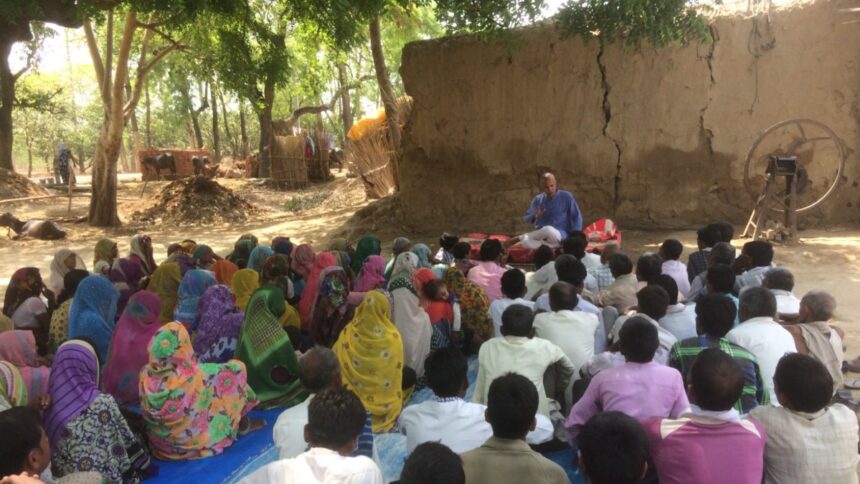
The answer may lie not only in how much we invest, but in how we think about change itself. Few people have spent as much time grappling with that question as development practitioner Varun Vidyarthi. An engineer who did his engineering at IIT, Kharagpur and management studies from IIM Calcutta, Vidyarthi began his career at Tata Motors which was then known as TELCO . He could easily have continued down the corporate path. Instead, while still in his twenties, he left that world behind and chose to work in rural Uttar Pradesh. What began as a personal decision became a lifelong attempt to understand what real social change looks like. Over the next four decades, together with his wife, Amla, he helped pioneer the Self-Help Group [SHGs] movement in northern India through Manavodaya. Yet describing his contribution only in terms of SHGs would miss the deeper point. For Vidyarthi, development has never simply been about delivering solutions to people. It has been about helping people recognise their own ability to create solutions.
We often measure development by what has been built or delivered – schools, roads, toilets, hospitals, bank accounts, digital platforms or livelihoods. These achievements matter enormously, but they tell us little about what happens after a project ends. Does the community continue moving forward on its own? Do people feel confident enough to make decisions together, or does progress depend on someone from outside returning with the next project?

Vidyarthi’s work suggests that lasting development begins with agency, even before infrastructure or finance enters the picture. Together with development scholar Patricia Wilson [University of Texas, Austin] he explores this philosophy in Development from Within, arguing that sustainable change cannot simply be delivered to communities. It must grow through dialogue, trust and collective reflection. This idea is perhaps best illustrated by the Self-Help Groups that became central to Manavodaya’s work. Most people understand a Self-Help Group primarily as a financial institution. Women come together to save money, build a common fund and gain access to credit. Vidyarthi sees something deeper, ‘democracy in its smallest and most practical form’. When women who have rarely been invited into public decision-making begin meeting regularly, debating rules, resolving disagreements, holding one another accountable and making collective decisions, something important starts to change. Money may be the entry point, but confidence becomes the outcome. People who once saw themselves primarily as beneficiaries begin to see themselves as citizens capable of shaping their own futures.
One of the most striking lessons from Vidyarthi’s work is that progress may begin with rejection. Reflecting on years of dialogue with rural communities, he describes how the first conversation with a village often fails. People question the ideas being presented or reject them altogether. Most organisations would see that as a setback, but he sees it differently. In Development from Within, he writes, “Poverty often produces courtesy that leads to a false acceptance of an outside intervention.” A community that politely agrees with everything may not actually be participating. A community that pushes back, asks difficult questions or rejects an idea is engaging with it on its own terms.
That observation extends far beyond rural development. In public policy, philanthropy, education and business, we often mistake agreement for success. But disagreement can also be a sign that people feel confident enough to speak honestly. In a development culture preoccupied with quick wins, visible consensus and measurable outcomes, this insight matters. Listening may be more useful than persuading, disagreement may be healthier than easy consensus, and trust often takes longer to build than project timelines allow. Communities are not problems waiting to be solved. They are partners whose experiences and judgment must shape the work. The same idea informs Vidyarthi’s understanding of leadership. We often celebrate leaders for building institutions that depend on them, but his measure is almost the opposite. A good facilitator leaves behind people who no longer need the facilitator. Success is not about becoming indispensable. It is about helping others become independent.

Imagine if every NGO intervention, government programme, CSR initiative and philanthropic project were judged not only by how many people it reached, but also by a more demanding question – did people become more capable of solving their own problems after we left? That question could change how we think about impact. It would shift attention from delivery to ownership, from dependency to capacity, and from short-term outputs to long-term confidence.
India is building world-class digital public infrastructure, expanding manufacturing, investing in artificial intelligence and strengthening its global economic position. These achievements deserve recognition. But as we imagine India’s future, Vidyarthi’s journey offers an equally important reminder. Technology can connect villages, capital can create opportunities and policies can expand access, but none of these automatically creates trust, confidence or the belief that one’s voice matters.
Those qualities are built more slowly. They emerge through listening, dialogue, shared responsibility and the experience of making decisions together. They grow when communities stop seeing themselves merely as recipients of development and begin seeing themselves as its authors. That may be Varun Vidyarthi’s most valuable contribution. His work reminds us that development is not only about improving people’s lives. It is also about helping people believe they have the power to improve their own. The distinction may seem small, but in practice, it changes everything.
Venkatesh Raghavendra is a social entrepreneur working on issues of access to safe water, youth and opportunity-creation and related areas. Pragya Raj Singh is a development and philanthropy professional working at the intersection of global partnerships, social innovation, and India-U.S. engagement.