


India
oi-Gaurav Sharma

Delhi Police have registered at least three FIRs after protesters tried to gather at Jantar Mantar to demand the resignation of Chief Election Commissioner Gyanesh Kumar over alleged irregularities in the Special Intensive Revision of electoral rolls. The cases follow a day of detentions, heavy security deployment and restrictions across central Delhi, where police said prohibitory orders were already in force.
According to senior police officers aware of the matter, the FIRs were lodged at Parliament Street and Connaught Place police stations on the basis of daily diary entries made by police personnel. The cases have been registered under Section 223 of the Bharatiya Nyaya Sanhita, which deals with disobedience to an order lawfully issued by a public servant.
Delhi Police registered three FIRs under Bharatiya Nyaya Sanhita Section 223 after protesters attempted to gather at Jantar Mantar for CEC Gyanesh Kumar’s resignation over electoral roll irregularities, detaining about 1,000 people amid heavy security and prohibitory orders.

Why Delhi Police filed FIRs after the Jantar Mantar protest
Police officials said the protesters violated orders issued under Section 163 of the Bharatiya Nagarik Suraksha Sanhita in the New Delhi district. These orders restrict public gatherings, demonstrations, processions and similar activities without prior permission. Jantar Mantar, a traditional protest site in the capital, falls within the heavily policed central district.
One officer said no individual or organisation had been named as an accused in the FIR columns. However, the contents of the FIRs mention the organisers and groups that proposed or joined the protest. It was not immediately clear whether police had added any other penal provisions apart from Section 223 of the BNS.
The protest had been called by several political, student and civil society groups. These included the Aam Aadmi Party, All India Students’ Association, Students’ Federation of India, National Students’ Union of India, Indian Youth Congress and other youth organisations. Their stated demand was action over alleged irregularities in the Special Intensive Revision process and the resignation of the CEC.
Delhi Police said the restrictions were meant to ensure public safety, maintain order and keep traffic moving in the high-security zone. Before the scheduled protest, police also posted an advisory on social media warning that violations of the prohibitory order could invite legal action under Section 223 of the BNS and other applicable provisions.
What Section 223 of BNS means for protesters
Section 223 of the Bharatiya Nyaya Sanhita covers disobedience to an order issued by a public servant. If convicted, a person may face simple imprisonment of up to six months, a fine of up to ₹2,500, or both. The punishment can be higher if the violation is found to endanger human life, health or safety.
In cases where disobedience causes, or is likely to cause, danger to human life, health or safety, or leads to a riot or affray, the punishment may extend to one year in jail, a fine of up to ₹5,000, or both. Police officers cited this provision while explaining why FIRs were registered after the attempted gathering.
Under the Section 163 BNSS orders cited by police, assemblies of five or more people, public meetings, processions, demonstrations, picketing, dharnas, slogan-shouting and speeches were barred without permission. The order also prohibited carrying firearms, banners, placards, lathis, swords, sticks, brickbats or similar articles in the restricted area.
The legal action comes at a time when public protests in central Delhi often face layered permissions and restrictions because of the presence of Parliament, central ministries, diplomatic zones and key government offices nearby. Police usually cite security, traffic and law-and-order concerns while regulating gatherings in the New Delhi district.
Nearly 1,000 detained during the protest attempt
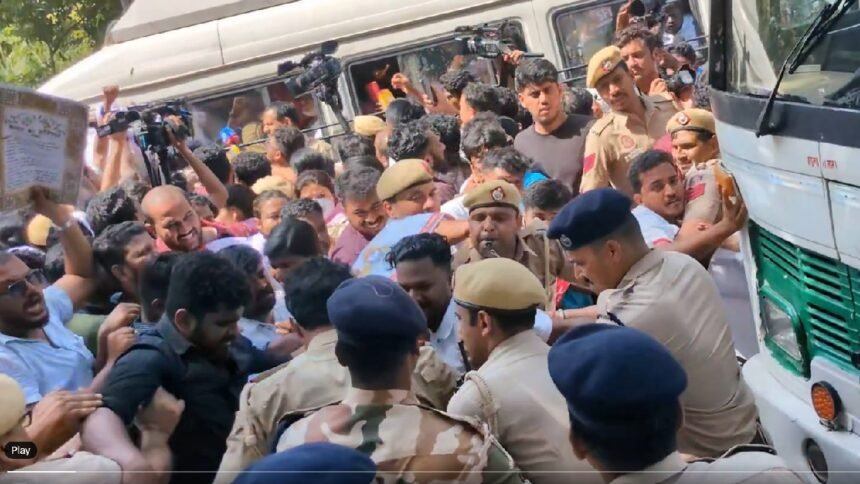
Police detained around 1,000 people across Delhi as groups attempted to reach Jantar Mantar for the 11am protest. Around 750 were detained from areas near Jantar Mantar, while hundreds more were picked up from other parts of the city. Police also placed around 200 people under house arrest in the morning.
Those detained from the streets were taken in police buses to different police stations. Among the detainees were former Delhi chief minister and AAP leader Atishi, AISA president Neha Bora and Swaraj India leader Yogendra Yadav. AAP leaders, civil society activists, members of Left-backed student groups and Congress youth workers were also detained.
More than 5,000 security personnel were deployed in and around Jantar Mantar to stop protesters from reaching the site. The large deployment reflected the police assessment that multiple organisations were mobilising supporters for the demonstration. Barricades and detentions were used through the day to prevent crowd formation near the protest venue.
The controversy centres on allegations raised by opposition-linked groups and activists over the Special Intensive Revision of electoral rolls. Such revision exercises are meant to update voter lists by adding eligible voters, removing ineligible entries and correcting details. Disputes around voter rolls often become politically sensitive because they affect participation in elections.
The Election Commission has not been quoted in the police account of the FIRs. The protesters, however, have framed the issue as one involving electoral transparency and accountability. Police action, meanwhile, has focused on the alleged breach of prohibitory orders rather than the substance of the allegations raised during the protest call.