India
oi-Madhuri Adnal

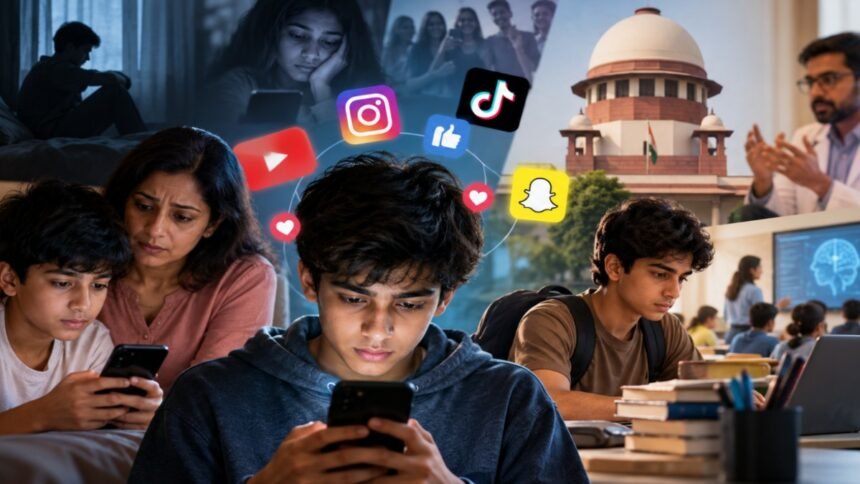
As India considers tighter rules on social media access for people under 18, the debate is no longer only about setting an age limit. For parents and mental health professionals, the bigger challenge is helping children navigate a digital world they are already deeply exposed to.
The Supreme Court has asked the Centre to examine statutory safeguards for minors using social media, including whether children below 18 should be allowed to independently create and maintain social media accounts.
India is considering stricter social media rules for under-18s, with experts advising digital education and growing independence over bans, to address online risks like addiction and misinformation while enabling learning.

While stricter safeguards could limit some risks, a clinical psychologist and a parent of two boys, one above 18 and the other younger, say children also need guidance, digital education and gradually increasing independence.
Psychologist: Parents need to monitor, not simply ban
Speaking to Oneindia, Clinical psychologist KC Sadanand of Mindbody Cold Laser Centre said parents should remain involved in their children’s digital lives, particularly during their school years.
“Parents should be able to see what their children are doing,” Sadanand said, adding that access through parents’ phones or login credentials could provide some level of supervision.
At the same time, he said children need some freedom. Rather than completely cutting them off from technology, parents and schools should teach them how to identify appropriate and inappropriate content.
Schools, he said, also have a role to play by introducing digital education, much like sex education, to help children understand what they encounter online and distinguish educational content from vulgar or inappropriate material.
A complete ban may also have unintended consequences, Sadanand said, because children increasingly use digital platforms to read, find information and learn.
“Schools are increasingly using AI and social media as learning tools,” he said, adding that social media is no longer used only for entertainment.
This means strict restrictions could also affect children’s access to useful information and educational content.
At the same time, simply blocking access may not stop children from looking for inappropriate material.
“They will find other ways,” Sadanand said, pointing to the possibility of children turning to other platforms or using methods to bypass restrictions.
Social media can affect confidence and self esteem
Sadanand also pointed to the effect social media can have on teenagers’ confidence, self esteem and attention.
When children post something and begin receiving likes and other forms of online validation, they can start building a virtual world that feels increasingly important.
“They can become addicted to that, and that is not the same as real life,” he said.
Social comparison can also affect how teenagers view themselves, particularly when it comes to physical appearance.
“If a child sees something on social media or compares themselves with others, it can lower their confidence,” Sadanand said.
He said some level of restriction can therefore be healthy, but social media itself should not be treated as entirely harmful.
Parent: Children are spending too much time in a virtual world
For one Bengaluru parent with two sons, one above 18 and the other younger, the changes brought by smartphones and social media are already visible at home.
“Children are spending so much time in this virtual world that they are not really living in the real world,” the parent said.
The parent said children’s lifestyles and thinking have changed because of what they see and consume online. Some children, the parent said, can become more withdrawn as they spend increasing amounts of time online.
But the parent also acknowledged that completely restricting technology is not realistic.
“We cannot completely restrict them. To some extent, social media and technology can also be helpful,” the parent said.
The challenge, therefore, is finding a balance between protecting children and preparing them to eventually manage their own digital lives.
Fake, violent content adds to parents’ concerns
The parent also raised concerns about the amount of misleading and inappropriate material children encounter online.
“There is also a lot of fake and misleading content, especially on social media. Children are exposed to wrong signals and wrong messages, and they consume this content 24/7,” the parent said.
The concern extends to violent content as well. The parent argued that children cannot always be blamed for what they consume because digital platforms expose them to a constant stream of material.
The parent also spoke about the pressure around smartphones, saying some children become demanding about getting particular or expensive devices.
Both the psychologist and the parent pointed to the need for a gradual shift from parental control to personal responsibility.
Sadanand suggested that parents monitor mobile phone use particularly until around Class 10. As children move into Classes 11 and 12, parents can gradually give them more freedom while continuing to guide them.
The parent similarly said that by around 17 or 18, children should begin taking greater responsibility for their decisions.
“You cannot completely control everything they do. You have to give them some independence and allow them to make certain decisions,” the parent said.
But independence, the parent stressed, does not mean leaving teenagers without guidance. “They still need to understand the difference between what is healthy and what is not,” the parent said.
Self awareness may matter as much as restrictions
The parent believes that helping children develop self awareness is an important part of preparing them for adulthood.
A child needs to understand their own behaviour, choices and the consequences of those choices, the parent said. Value based or spiritual learning could also help develop that awareness, the parent added, without necessarily requiring children to follow a particular practice.
The psychologist’s argument follows a similar line: children need to understand what they are consuming online and how they are using social media, rather than simply being told what they cannot access.